Sunday, July 14, 2013

Taking Flight


In lavender chiffon and and on a day with just the right breeze to keep her in motion, she greets the visitors to Lavender Hill Farm outside Boyne City, Michigan. Early lavenders are in bloom now (some are still to come--I had no idea there were so many different kinds! And white ones!) and the moving air is gloriously scented. I loved the way her dress and arms move with the air, and come to rest when the wind pauses. I spent quite a while thinking about the idea for this human simulacrum and wondering who the artist is, and if she does it for love or for money. The white gloves seem like a double layer of stitched felt and have the right weight and substance to catch the wind and make such a fine confident walking illusion. The hat is perfect and the ropes of beads at her neck also!

Recently the mail brought the volume Black Aperture, by Matt Rasmussen (Louisiana State University Press, 2013) which  recently won the Walt Whitman Award from the Academy of American Poets, and thus wound up in the mailboxes of those of us who belong to the support group. Often it takes me some time to warm up to a new poet, but this was interesting right away, and not just because of the backstory, a brother's suicide. The poem I finally chose is this one.

747


The man who 
drew the first 

map was able
to see through

the eye
of a bird,

Fields speckled
with snow

are covered
in clouds

like dark faces
veiled twice

I have told
you too much,

forgive us both,
O sun,

O stainless fuselage,
weave us

between the veils
before we darken

and dip into
the twinkling net.

Each small town
a blemish

on the night's skin,
each city

a tumor of light.

Matt Rasmussen, op. cit. pages 8-9

There is a great deal to think about in a poem with such short lines, which starts out with
such a promising image. I found it surprisingly difficult to type the linebreaks and had to go back to
insert a return. Right now I am scratching a recent mosquito bite and cannot think about poetry anymore.
But I am planning to write a poem with VERY short lines. Wish me luck! Good night.


Saturday, July 13, 2013

My Golden Baby Sister at the beach


I am still working with the slides taken by my mother from 1953-1970s. This was cropped from one of the earlier ones, maybe from the summer of 1954. The light is just about perfection, and the wet sand the perfect background color for the child's coloring. There is even some motion, as she digs in the sand. Mom had a good eye.

Because of the beautiful, tender simplicity of this picture, tonight I have selected some of the haiku of Hosai Ozaki, which Hiroaki Sato translates to be printed on one line. Each line is a separate poem, complete in itself. They are from the one of my favorite books:
Right Under the Big Sky, I Don't Wear a Hat, Stonebridge Press, 1993. Hiroaki Sato has dedicated the book to the poet John Ashbery. Surprises abound on printed pages! Pick up a book at random and look!

Having become a pickle tub weight, smug, a hunk of gravestone

My long-time-no-see face is reflected in the pond I've come to

A spider has caught a dragonfly under the eaves I'm living

Letting a lot of frogs croak I turn off the lamp and go to sleep

I ended up lending my only umbrella

Lake houses in a row, catching small fish, their life

The nail I missed cocked its head

With a face saying I caught something, a child came out of the bush

I go in and out of the back wooden gate, morning glories turn into seeds

The letter I'm writing lying down is peeked in a by a chicken

I walk with children, at our feet waves roll

I hope you can get to the beach this summer, if you want to! Sleep well tonight.


Friday, July 12, 2013

A Whole Roll of Film

My mother took this picture of me days before I left for college in 1953. Despite the fact that cash was short because we were fixing up our old farm, she used a whole roll of film! "You'll never be the same," she said, and it was true. I was gone to Arizona by the time the pictures were developed and only remember seeing a couple of them. These are all rare pictures of me without glasses, (which my mother had instructed me to remove) which I had been wearing since I was nine years old.
I've been working on a batch of these scanned slides today and yesterday; I want to get them tuned up, uploaded to Flickr, labeled, and shared with the rest of my family. It is fun to see these pictures, and also a little sad, because now (if I'm lucky) I have less time left to live than my whole 17 years up until that point. And my brothers and sisters (all younger) were each one of them SO terribly young!

Here is another poem from Dark Elderberry Branch; poems of Marina Tsvetaeva. The translation is by Ilya Kaminsky and Jean Valentine, page 15.

I know the truth


I know the truth! Give up all the other truths.
No time on earth for people to kill each other.
Look---it's evening; look, it's nearly night. No more
of your talk, poets, lovers, generals.

Now no wind, and the earth is sprinkled with drizzle,
and soon the blizzard of stars will go quiet.
And soon, soon, to sleep, under the earth, all of us,
us who alive on earth won't let us sleep.

1915

Read this short account in Wikipedia of Marina's life. It will make you relish the pleasures in your own life, I am sure. In the translation above, I am particularly fond of the "blizzard of stars" and the way the word "drizzle" chimes to that.  I also think the one word, "generals" introduces a topic of which all of us are aware, and about which there is nothing that we ordinary folks can do. Tonight, I was asked what "depleted uranium" was by someone who just encountered the phrase in a news article about a veteran's health problems, We read the article in Wikipedia. I'd do something about the way were have strewn and are strewing this stuff about on earth in many places if I could. Or if I could choose just one thing to "do something about" how would I choose?? Perhaps I'll go out now and look at the blizzard of stars, and try to think of some way to do something useful. Good Night.

Thursday, July 11, 2013

Summer on The Farm, 1950s

 Here is another one of the family slides. I just had 1468 of them scanned, but you won't have to see all of them here. Eventually most of them will be on Flickr, but as I am cropping some and straightening some and color-correcting some; this all takes a while.These slides have been marinating for a long time, and the technology has improved.

Here are three of my brothers doing what boys did then. I think that is John in the air--but it could be Richard--how to tell?--with Robert and David as onlookers. This time in our family life is mysterious to me, since at that point I had left home. My Childhood Home was in the Village of Scotia, New York, where I spent my first fifteen years. But the boys spent a great part of growing-up-time here on The Farm. (Not that we grew much: a garden, some horses and some chickens; mostly children.) I love the great arching swing of this photo taken by my mother Wild freedom!

Tonight we have a work by Steve Kowit, who lives on the four-point-five acres near Chula Vista, mentioned in the poem. He has written a good guide to writing poetry called In the Palm of Your Hand; The Poet's Portable Workshop. Several fine collections of his poems have also been published. This is another poem from A Bird Black as the Sun; California poets on crows and ravens, Green Poet Press, 2011.


RAVEN


Squawks from a raven in what used to be Jack
Funk's field over the fence, scolding
me til I look up and see that the hills
are still there, that the day
couldn't be lovelier, sweeter. Susan Green's
little girls are chatting in singsong
up in the tree house,
in what used to be Dempsey's old place
to the west, & who will stroll over these four-
point-five acres of rolling high-desert chaparral
when we two are gone?----The tin barn.
The pump house and shed. That underground stream
from which we've been drinking
our fill these dozen years.
Who'll own all this dusty blue mountain lilac,
the aloes & roses & pines & bright orange iceplant?
Who'll walk in the shade of that live oak
under which Ralphie &  Ivan & Charlie
& Eddie are buried? Who'll watch the quail
flutter out of the brush & the rabbits
scurry for cover? Who will these granite
boulders & lovely agaves belong to
when you & I, love, are buried
& long forgotten?----Forgive me,
sweet earth, for not being shaken more often
out of the heavy sleep of the self.
Wake up! Wake up! Scolds the raven, sailing off
over the canyon, Wake up! Wake up! Wake up!
                                                                            by Steve Kowit, page 129

First, I want you to say, "Jack Funk's field over the fence, scolding . ." Say it a couple of times!
Then I want you to follow the ampersands through this poem and note how they support the structure.
Then I want you to read the whole poem out loud. Twice.  Sleep tight!


Posted by Picasa

Wednesday, July 10, 2013

1955, & all that "O things going away!"


I just got back the group of some of my mother's slides that I sent to be scanned! This picture that I don't remember ever seeing was in it. My husband has just come to my parent's house near Schenectady where I stayed during his basic training. It is near Thanksgiving and I felt very shy about meeting the train in one of my new pregnancy smocks. At the train station, I didn't recognize him when he got off the train. They had cropped his beautiful hair, given him military eyeglasses (he went away wearing classy horn-rims) and he had lost a lot of weight. In mid-December, I joined him at Fort Sill in Oklahoma, where he did the rest of his Army service, and our daughter was born.

I just sent the next to last batch of my parent's slides to Scancafe.com for scanning. I highly recommend their service! These slides (this is one of them, taken by my mother) are old, and often oddly exposed, since you had to set your exposure for each shot, and the slide film was pretty unforgiving. This was probably taken with a Contax or Contessa camera, both of which my folks got when my dad was on a business trip to Europe. I still have these cameras, and fiddle with them once in a while. I took the Contessa to college with me and it was my family camera for many years. I've had all those slides scanned, too, in the last two years.

Today (it's the middle of 2013!) we went on an excursion to a lavender farm. Fields of many different varieties of the scented stuff, some in full bloom, some of it not yet in bloom. Naturally there was a gift shop. And lavender goat's-milk soap for $7 a bar. You can choose the bar with little scratchy bits of lavendar flowers or the kind with no bits.

Tonight's poem was not published by Philip Larkin while he was alive. He left instructions that his diaries were to be destroyed and his assistants duly shredded them; it was a sizable job. He left instructions in his will to destroy his unpublished work unread; but he also gave his literary executors permission to publish what they wished. "The legal word for a will which contradicts itself in this way is "repugnant." Larkin's will was repugnant in this sense. It doesn't help anybody." (Isn't that wonderful??) This information and quote is taken from an article by noted British poet and critic James Fenton in the Summer, 2013 issue of the Threepenny Review, titled  "What Are We Going to Do About the New Philip Larkin," pages 7-10. This is a wonderful article, a review and consideration of Larkin occasioned  by the publication of Larkin's Complete Poems in 2012  by Farrar, Strauss and Giroux. Fenton  makes a good case for reading Larkin's published volumes in reverse order. He also mentions his surprise at the many unpublished, untitled poems that follow one another in the Collected without a typographical clue as to where a new fragment begins. You can figure it out, but he suggests it was a bad mistake for the reader. Fenton calls this the "yard-sale effect." This review is chock-full of information about Larkin's entire output.

Holiday

Clouds merge, the coast darkens,
Sunless barley stirs,
The sloping field alters
To weed-ribboned rock,
Waders and lichens,
The sea collapses, freshly.

A vacant park inland
Is roughened by wind,
Trees throng the light-oak chapel,
Storms-spots quickly round
A railed tomb of ssilors.
The house is shuttered.

Embedded in the horizon
A tiny, sunlit ship
Seems not ot be moving.

O things going away!

Philip Larkin, as reprinted in the Threepenny Review, Summer, 2012, page 10.

Tuesday, July 09, 2013

A Memory Swan

Back in ancient times, when I sometime used the new roll of color film this developing outift used to send me whenever they developed and printed a roll, I stopped on the path when I saw the swan, and waited for him to swim away from the foliage, so I could get the reflection. Some of my friends that were on the ginko (walk for the purpose of composing haiku) told me to hurry up and rejoin the group.
This lone photo from the 1980s turned up last year when I was going through some papers. I have no idea what other photos I took that day, or what haiku I wrote. But the feeling of seeing a sudden swan on the water, surrounded by foliage in dappled light is still quite clear. Because of the odd film and the intervening years, the colors in this print are not true to nature. But I like the muted, somewhat limited and subtle palette of toned-down color. There is an iPhone program from Adobe that takes the main colors from a photo and turns them into a set of color blocks, like paint chips. I'd like to try that on this picture. I think I would see some deep greens, some brighter greens, some muted blues and a quite a bit of a sort of light tan, with a lot of almost-black, and just a trace of something reddish near the top,

Lately I have been looking at a blog called My Scandinavian Home. What seems to tie the homes together (it's not just one, but a lot of different homes, sort of like decorator pornography) is that they are ALL WHITE! They might have some wooden furniture, or some black accents, but the walls, drapes, floors and much of the furniture is white, white, white. It's oddly beautiful and compelling and sort of scary. Need I add, there is NO CLUTTER (and not much evidence of actual human life. . .) and I don't see any books. But these spaces are very beautiful, and I sort of wish I could . . . etc.

Tonight's poem, naturally, is from A Bird Black as the Sun; California Poets on Crows and Ravens,  Green Poet Press, Santa Barbara, 2011. Maybe, later, I can find (or make) a white bird book, for quick reference..

KNOWING

She said she would return
as a crow,
swarm on the spiked branches
of Monterey pines
with others in her flock
Not some regal raven,
but a so-so black bird

In life, she dressed
in peacock feathers
and amethyst beads
Now she'll hover,
a dark phantasm

Perhaps in the long days
of her dying
she kenned
an elegant coherence
in the world
black silhouette
against almond sky.

Charan Sue Wollard, page 128

The form is three stanzas of 7, 5, and 7 lines. I don't see syllabics, or a metrical pattern. And of course, the word I wanted above for the tan color is "almond," If you could return as a bird, what bird would you be?
Good night! And in your dreams, try to fly!
Posted by Picasa

Monday, July 08, 2013

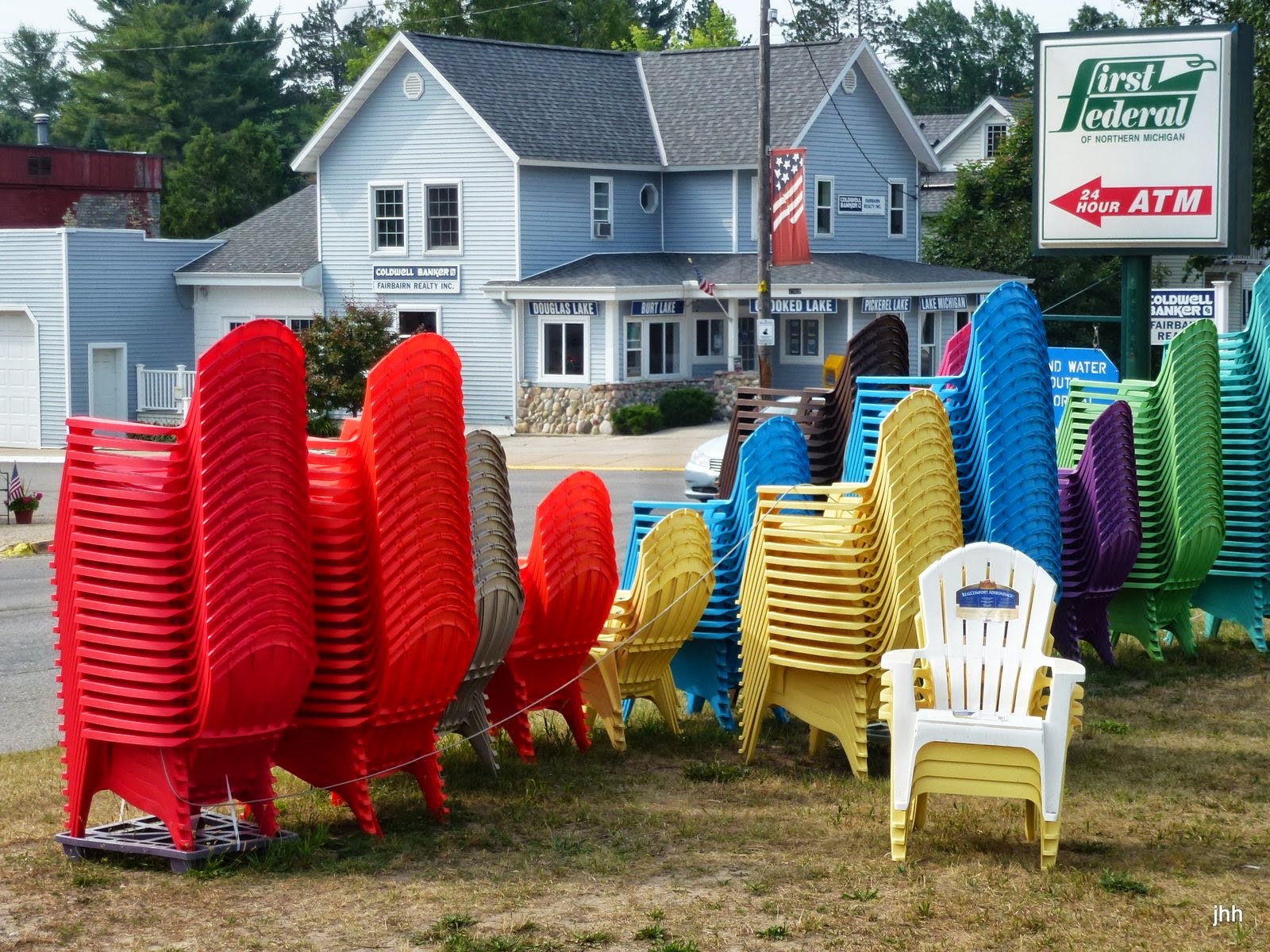
In Alanson, it is Summertime!


Fairbairn's (family-owned for more than 100 years) hardware store in downtown Alanson, Michigan, gets a truckload of these chairs each summer, stacks them up, and sells them all summer long. Some of the most populat colors are gone already (this shows the last white one, which has since been sold.) It is quite fun each time we come to town to see how the stacks have dwindled as the season progresses. At night they are chained up here beside the highway. I enjoyed watching a couple fit two of them (purple ones!) into a small hatchback a few weeks ago, but I couldn't manage a picture of that. I might buy a couple of these chairs  myself (I love the bright candy-colors, but favor, cowardly, the simple tan color, which is almost gone.) except that this is the WORST mosquito year in memory and we are not sitting around outdoors yet. It feels like never, but it should be possible later in the summer. There ARE fireflies, but I turn off the lights to watch them through the window. And tonight, I should report, there are no sounds of fireworks!

In the background of the photo, you can see the cute gray real-estate office that one of the Fairbairn sons created out of an old place that has housed a variety of different enterprises, most recently a coffee shop.
The heart of the Village of Alanson (check it out on Google Earth) is strung out along the path of the Crooked River, part of a system of lakes and rivers that made it possible for the Ottowa and other tribes to paddle across the tip of Michigan from Lake Michigan all the way to Lake Huron. There is a little museum in town that celebrates that Inland Waterway. On the non-river side, there used to be a railroad that ran through town (I think it brought vacationers and took away lumber) and the old depot currently houses a nice restaurant. People came "up north" from the southern part of the state to get away from summer heat. The museum has photos of them in their 19th Century holiday dresses, hats, and stiff tailoring.

There have been many changes in village and town life in America. I think the networks of people that these towns supported were a great strength that the country has lost. It is fine to see people working so hard to preserve what is left, but it also looks like a precarious enterprise. What do you think?
Muso Soseki , famous for the gardens he designed, as well as his Zen teachings, lived in Japan from 1275-1351. In this poem, translated by W. S. Merwin and Soiku Shigematsu, he puts some faith in the future, Maybe I should, too.


For Myo's Departure for Shofuku-ji


A single true man 
        appears in the world
                and all falsehood vanishes
No need to worry
        that the Way of the Patriarchs
                seems to be declining
This time
        your ax of wisdom
                has found wings
Some day
        surely it will rise up
                and fly

From Muso Soseki's Sun at Midnight, Copper Canyon Press, 2013, page 90.

I am inspired by the way the margin rolls in and back again and by the unpunctuated triolet structure. The single capital letter at the beginning of each section gives a nice artistic touch. Of course, we cannot reproduce in translation the effect of Japanese calligraphy, but attention to the arrangement on the page suggests a similar feeling. Write something pretty tomorrow, using color, special paper or some other method of artistry. Good Night!


Posted by Picasa