Tuesday, July 14, 2009
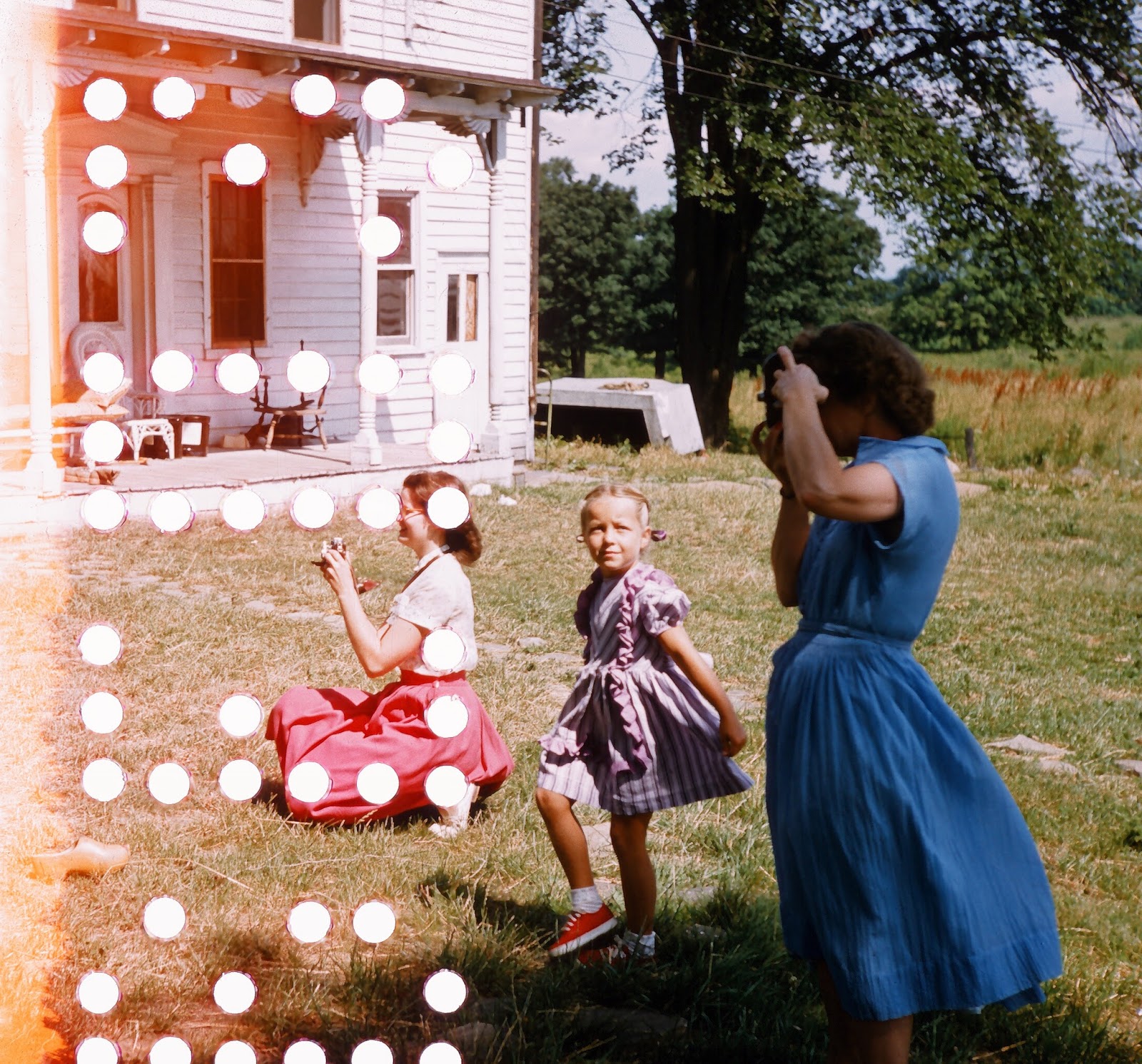
My mother in front of my childhood home
This camel-colored coat my mother often wore, and I remember it well. About this time, when my four brothers were born in five years, she stopped bothering as much about her hair and her clothes.
This pictures resonance for me tonight is in the cobblestone retaining wall, which my parents later removed and replaced with a rock garden. So far tonight, I have touched on three other memory threads that I would like to develop. But, sticking to this one. . .
This rock wall was topped with a flat cement slab ideal for playing on and the scene of many of my early memories of solitary play. Here is a poem I wrote about one of them.
Ritual
Large ants, black and glossy, make Indian-file trails
across the corner of the wall by the entrance stairs.
I sit and watch them; then cut one not quite in half
with the sharp serrated edge of a milk bottle cap.
The ant keeps moving but stops getting anywhere.
Of course it can utter no little cries.
The marching line of ants shifts, moving around
the chosen ant. I lift it to a doll’s house ironing board
which has folding legs and a tiny fabric cover but no iron.
After watching the ants another long time, I chose
one at random and press on the bottle cap, but gently
so as not to sever the ant. Important meaning fills me;
I sit with the sun’s warmth on my shoulderblades,
on the roots of my pigtailed hair, watching, watching ants.
This is one of my earliest poems, and tries to capture what was a very powerful memory for me. Before my brother emails to tell me that "shoulderblades" is two words, I must mention that here the I prefer the rhythm of reading it as one. Of such tiny decisions is art made.
I hope to keep up my posting now. There are a lot of things I want to consider. Stick with me, small faithful band of readers!
Tuesday, June 23, 2009
Susan gives a puppet show

Robert claps, floodlit
Originally uploaded by jhhymas
As we drove to Provo, my brothers regaled me with storage stories from friends. There was the rat story, the mildew and damp story and the cockroach story. When we got there, none of these stories came true. Thank you Lockbox!
It took two pickup-loads to get the stuff to the temporary sorting zones at their nearby houses. In Salt Lake, we cut it by half and then we loaded it again and went to Kaysville. With the help of nieces, sisters-in-law we sorted, categorized and tossed for nearly the whole week. I have to say that one of the biggest hits was the love letters exchanged between my mother and father the year they were engaged--he was living in Schenectady (working for GE) and she was still in Arizona, working as Assistant Dean of Women at the University. The letters were tied into two brick-sized bundles, Mom's with a narrow pink ribbon and Dad's with a necktie. It looked as if they had been tied that way since 1934. My niece, Marilee, put them into page protectors and binders, and is working on getting them into the correct sequence. Most letters were in postmarked envelopes, but some of the postmarks were illegible and some letters were begun with "Sunday evening" and the like.
To be continued . . .
Wednesday, June 10, 2009
Art and Literature; my phantom sketchbook

I love to give my grandchildren something to draw on and something to draw with! The easy and focused way they work on a drawing makes me think AGAIN that I need to use my sketchbook more. Just pick it up! I say . . .
I'd love to look through an actual sketchbook of all the sketches I was just about to draw. And now there is Twitter and Facebook, in case I thought of actually creating art or drafting some haiku.
Looking at Sketchblogs tonight, I found a sketcher thinking about getting a Kindle. So I wrote her a quick note, also shared below. You might call this: I love my Kindle, BUT . . .
I got the Kindle for Christmas six weeks before Kindle2 came out. I use it I lot, but miss: 1) color illustrations!!! in art books 1B) the section of pictures in a biography 2) using an index to check on something I read earlier in the book, or identify something 3) looking at the notes or sources AS I AM READING 4) photocopying a quotable page 5) just riffling through the book, and peeking forward or backward 6) the actual feel of paper 7) being able to pass on the book to someone I think will like it after reading.
I should mention that I read more than half non-fiction; Kindle works better for fiction, unless you want to look for a remembered passage.
I am crabby about the costs, many books I want to read cost MORE than $9.99, which seems too high already. I would like about a $5 price point for most items. There are LOTS of free classics available--I have read some great stuff just because I'd always meant to.
I don't like it for the newspaper, yet; reading news online is a MUCH better and richer experience.
The technology is not unproven--it really works and it is REALLY impressive fun to get a book instantly while someone is still recommending it to you!
Don't hang back! Unless you need the money for food. . .
Friday, June 05, 2009
Three ducks without a troubling thought and W.B. Yeats on Childhood
I might soon have to call this a weekly, not a daily blog. . . sigh. .
I have been reading and thinking a lot of posts, particularly about memory and childhood.
Many years ago, I picked up this copy of The Autobiography of William Butler Yeats. I don't think he put it together like this--it seems to have been assembled from various writings, perhaps after he died. This is from the first part called Reveries. I am wondering if this is anyone else's experience of childhood. I don't think I felt like this--but then I lived with kind parents, not distant grandparents. I would like to know what YOU, whoever you are, think about this:
"I can only remember my grandmother punishing me once. I was playing in the kitchen and a servant in horseplay pulled my shirt out of my trousers in front just as my grandmother came in, and I, accused of I knew not what childish indecency, was given my dinner in a room by myself. But I was always afraid of my uncles and aunts, and once the uncle who had taken the crowbar to the bully found me eating lunch which my grandmother had given me and reproved me for it and made me ashamed. We breakfasted at nine and dined at four and it was considered self-indulgent to eat anything between meals; and once an aunt told me that I had reined in my pony and struck it at the same moment that I might show it off as I rode through the town, and I, because I had been accused of what I thought a very dark crime, had a night of misery. Indeed I remember little of childhood but its pain. I have grown happier with every year of life as though gradually conquering something in myself, for certainly my miseries were not made by others, but were a part of my own mind."
From The Autobiography of William Butler Yeats, p. 5 in the edition I have.
Friday, May 29, 2009
Name Fifteen Books in 15 minutes!
The Little White Indian Boy; given to me at age 11 by my parent's friends when I started it while babysitting for them. I think they got it from the Book of the Month Club. It started my fascination with Indian Captivity Narratives, which endures to this day.
Mistress Masham's Repose by T.H. White which began my fascination with books about little people. (See The Borrowers, etc.)
Also a model of excellent writing.
Stuart Little/Charlotte's Web I think now that Charlotte's Web is the better book and an enduring classic, but true to my fascination with the SMALL, for years I preferred Stuart.
Gone with the Wind, which I read in one sitting far into the night about age 12 and rewrote the ending for YEARS!
Kristin Lavransdatter; this one took me all night (it's a trilogy) and I got up at 6:30 and went to high school. The impressive remembered thing (for this reader) was the handful of books (five, seven?) owned by this entire family in the Middle Ages.
The three perfect short novels (a previously assembled list) (not one superfluous or awkward word!) are:
The Life of Martin Guerre by Janet Lewis,
The Hessian by Howard Fast and
The Light in the Forest by Conrad Richter
The Shipping News--every odd person and word a delight, and completely unlike anything I knew.
The Face of Battle: A Study of Agincourt, Waterloo, and the Somme
also Fields of Battle: The Wars for North America both by John Keegan. I am still reading this military historian after seeing him on CSPAN's In Depth. These are quite short and perfect books, which gave me the ability to think about wars with balanced and factual information I never had before. You will never be the same, if you read the Face of Battle!
Cadillac Desert; the American West and its disappearing water, by Marc Reisner. Of all the ecology books, this really made me see how all life is interrelated. It opened my eyes in the way Silent Spring did for an earlier generation.
Father and Son by Edmund Gosse; a son's recounting of a dysfunctional relationship--really puts the nail in the coffin of unbending religion which comes before all else.
Now we have entered the biography/memoir zone:
Grant by Jean Edward Smith. A fantastic recreation of the life of the General and President, never dull, allowing opinions and conclusions to be stated, and recreating the life of an era.
The Road from Coorain by Jill Ker Conway
John James Audubon; the making of an American by Richard Rhodes
A life of Picasso (3 vols. so far) by John Richardson
Mornings on Horseback by David McCullough
The River of Doubt; Theodore Roosevelt's Darkest Journey
and Theodore Rex all these books on TR are good, can't choose.
Team of Rivals by Doris Kearns Goodwin
Wild Swans; three daughters of China
Party in the Blitz by Elias Canetti
Running in the Family by Michael Ondaatje
Angela's Ashes by Frank McCourt
Bells in Winter by Czeslaw Milosz is my favorite book of poems but I've had to leave the rest of the poetry off this list. It will require another post.
Have You Read 100 Great Books? I haven't dared to make a final count, but the list has more than 15. This is the book that started it all, an oversized paperback that I had in my teen years. It was assembled by asking 100 (?) of the famous, educated and smart to list their best 100 books. Then a master list was assembled of the 100 most-cited books. I made it my goal to read all of these. I had the most trouble with The Meditations of Marcus Aurelius, which I cannot claim to have finished. I also had trouble with Of Human Bondage and David Copperfield, maybe because the male protagonists were silly about women, if in different ways. But I read all the others and was quite proud of having done so. It was probably the first big goal I set for myself that had no relation to what others might plan or suggest for me, or indeed to anyting sensible or useful . . . Good night, for tonight!!


