Wednesday, January 23, 2019

Memories, hoping to resumes this blog


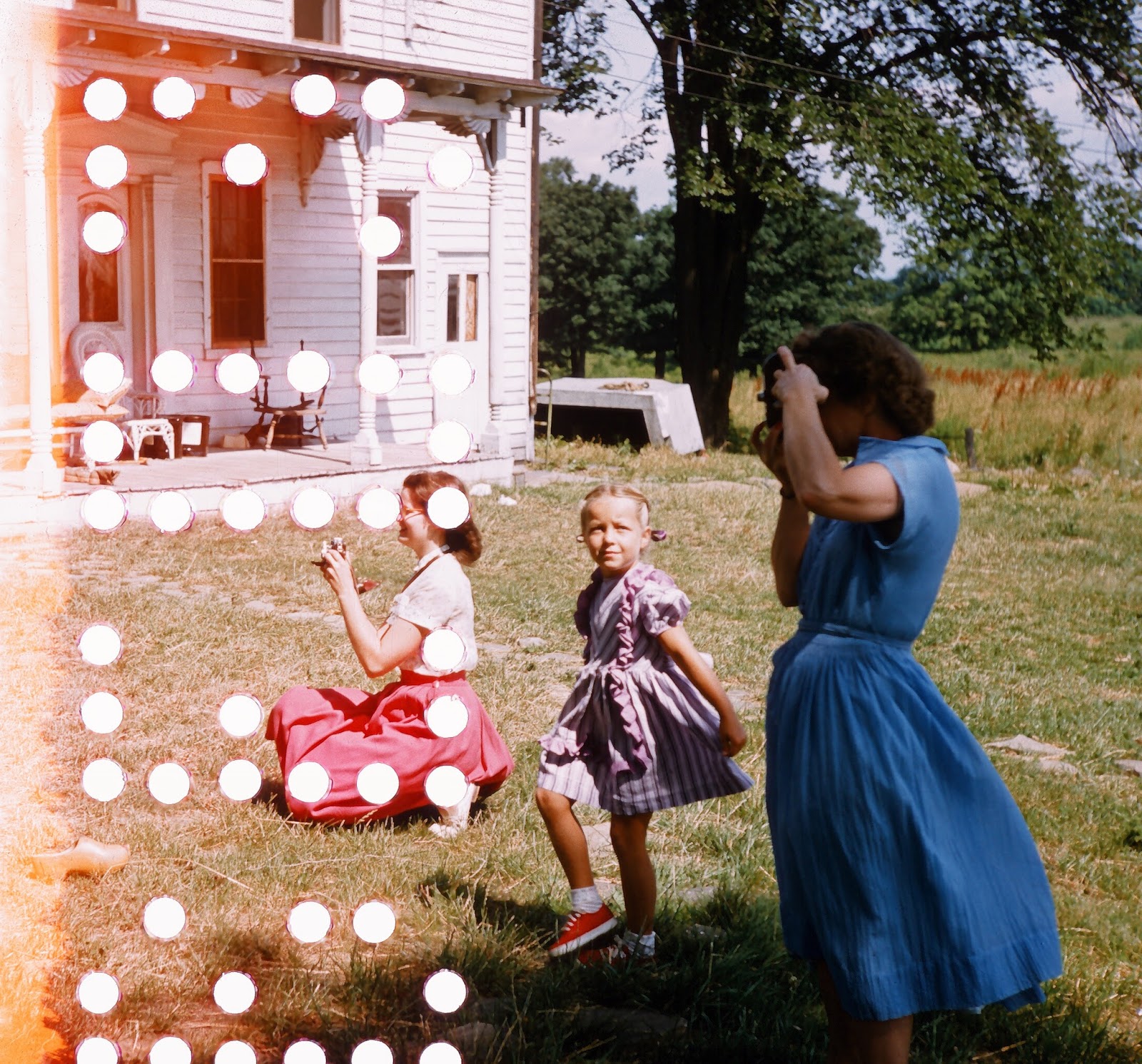
My mother with the movie camera.  I am taking slides in my favorite pink skirt, I think it is the the summer of 1953, but it could be 1954, my cousin Susan Peters might know what year they visited our Farm near Schenectady, She is the child on this picture. This shows the corner of the house that my father was lifting gradually with a jack; it is where he explained a plumb bob to me.


I have been reading Scott Momaday... this is about his father...

From The Names; a memoir, by N.Scott Momaday. page 41. University of Arizona Press, 1976.

I see. There us moonlight on the Southern Plains. I see the black trees in the north, where the river runs and my father has set out poles on the bank, When he goes before daylight with the lantern to take them up there will be catfishes on the lines, their heads flat and green and shining, and there wide mouths grinning under their whiskers.
There is a whole silence on the earth--only here and there are surfaces made of sound, frogs purring at 'the water's edge, a rooster crowing across the distance, the river running and lapping. And the plain rolls like water in the low light; the light is like chalk on the ripples of the land; the slow, warm wind seems to ruffle the soft light, to stir up like dust. Oklahoma shines like the moon.

Your assignment. Write a paragraph or two about your father. I am hoping to resume this blog...

Saturday, November 03, 2018

You who are a bird suddenly

This is a picture of my grandson, who is all grown up now. 
I just happened to run across it 
when I was paying for my Flickr account, 
which now belongs (weirdly) to Smugmug
and where I have about 30,000 photographs. 
I fell in love with his innocent expression 
all over again.


Aracelis Girmay


SECOND ESTRANGEMENT

Please raise your hand,
whomever else else of you
has been a child,
lost, in a market
or a mall, without
knowing it at first, following
a stranger, accidentally
thinking he is yours,
your family or parent, even
grabbing for his hands, 
even calling the word
you said then for "Father,"
only to see the face
look strangely down, utterly
foreign, utterly not the one
who loves you, you 
who are a bird suddenly
stunned by the glass partition
of rooms.
                  How far
the world you knew, & tall,
& filled, finally, with strangers.

This is the first poem in a new anthology assembled by the current US Poet Laureate, Tracy K. Smith, entitled American Journal: fifty poems for our time. I will be writing more about her soon; 
I have been very impressed by her work as Poet Laureate 
and by her recent autobiographical work, Ordinary Light.

Both the this poet and the Poet Laureate have good information posted on the Poetry Foundation website.

                      Your task for tonight 
is to write a poem beginning: 
"Please raise your hand..."


Friday, November 02, 2018

Not Nothing To The Crows

This is a picture of my father, Jack Hicks Hopper, 
and his older sister, Mary Lillian Hopper taken, 
I think, at the time of their train journey from Portales, New Mexico 
back to Arkansas where their parents had met and married. 
They went to visit relatives. Just before I died, 
Dad told me a memory of this train journey. 
The porter locked the doors of the restrooms when the train was in a station 
so freeloaders couldn't hide and avoid being asked for a ticket. 
isOnce, the little boy in the picture above happened to be inside 
when the door got locked and he was very frightened! 
More than seventy years later, he told me this story,  
just a few months before he died. 
I heard only a few stories of his early life from my father. 
My mother took up most of the air time...


A new issue of POETRY MAGAZINE came this week. I opened the first page to see if I had heard  of any of the poets. The Table of Contents is in the order of the magazine which follows. And the very first poem is by my friend, Lucia Perillo. I met her in the early 1980s in Bob Hass's poetry seminar at San Jose State. 
Afterwards, she went to Syracuse for a graduate degree
 in writing. I went to her wedding in Olympia, Washington,

Her books are terrific!

She has been dead now for just a little more than two years. She left us October 16, 2016.  At that time I had two unfinished letters to her on my desktop. They are still there. Unfinished, never sent or read. Consider this your wake-up call to finish any unfinished letters-in-progress!  

There is a good article in Wikipedia, which lists her publications and awards, which are plentiful. It is worth your while to get any of her eight books, which are all still available. Mostly books of poems, but also a book of stories and an autobiographical work, much of it concerning her life as a person with multiple sclerosis.

Here is Lucia's poem from Poetry, November, 2018 97, page 97.

                      Say This

I live a small life, barely bigger than a speck,
barely more than a blip on the radar sweep
through it is not nothing, as the garter snake
climbs the rock rose shrub and the squirrel creeps
on bramble thorns. Not nothing to the crows
who heckle from the crowns of the last light's trees
winterstripped of green, except for the boles
that ivy winds each hour round. See, the world is busy
and the world is quick, barely time for a spider
to suck the juice from w hawk moth's head
so it can use the moth a a spindle that it wraps in fiber
while the moth constricts until it's thin as a stick
you might think was nothing, a random bit
caught in a web coming loose from the window frame, in wind.

Lucia Perillo

Finding this poem has triggered me to start blogging again.
I hope to post something every day. See you later!!


Monday, February 05, 2018

House at the edge of the woods

At the right edge of the open snow in his drone photo taken by my grandson, Trey, is out beloved house at the edge of the woods outside Petoskey, Michigan. It has been more than three years since we were able to visit. But my heart is still living there, looking out at whitetail deer, coyotes., wild turkeys, and an occasional  sandhill crane or two, or even three.

I have been throwing away magazines. The January, 2015 issue of Harper's magazine was folded open at an article about Pablo Neruda's grave, which I had planned to read. So I read it. and liked it.  I thought I would tear it out and put it with the book of Neruda's selected poems. The book opened to this poem, Spanish and English on facing pages:

HOUSE

Perhaps this is the house in which I lived
when neither I, nor earth, existed,
when everything was moon, or stone, or shadow,
with the still light unborn.
This stone could then have been
my house, my windows, or my eyes.
This granite rose recalls
something that lives in me, or I in it,
a cave, a universe of dreams inside the skull:
cup or castle, boat or birth.
I touch the rock's tenacious thrust,
its bulwark pounded in the brine
and I know that flaws of mine subsisted here,
wrinkled substances that surfaced
from the depths into my soul,
and stone I was, stone shall be, and for this 
caress this stone which has nor died for me:
it's what I was, and shall be -- the tranquillity
of struggle stretched beyond the brink of time.

Pablo Neruda, translation by Nathaniel Tarn.
Neruda, Selected Poems, Houghton Mifflin, 1970, page 411.

Your task: write about your place on the earth. jhhymas


Friday, January 26, 2018

Marija Says

Today at the YMCA gym, E. introduced himself to us on the basis of the White Beard Connection. We had a long talk about life, and Hungary where he spent half his life, coming here with little English and getting a job as wheelchair/gurney pusher in a hospital. His brother was a high-wire acrobat and went back to Hungary where his line of work was more plentiful.
Thinking about this part of Europe and thus about wars, which have been so plentiful there (wars of which we are now more conscious again in these very peculiar times) reminded me of this powerful poem by Jean Pedrick, one of the founding women of Alice James Books (look it up!) If she were still among us, I think she would have been marching last week.


Marija Says

Grandmother said, they come from the east.oday
on horses. Watch the plain there
for the long cloud, thicker than smoke.
Hide what you can, potatoes, turnips,
anything that will keep, nothing to call
the bees. Then filthen and uglify yourself.
Roll with the swine until you retch, I beg you.

Mother said, they come from the north
like giant insects, beetlebacks on the feet
of millipedes. Whatever obstructs, they mount
and topple.When the ground shakes, when the crows
scatter, do everything she said. The food. The pigs.

They came from the sky. The pig exploded.
I was pasted with it. Even so, grew up, grew old.


Jean Pedrick
Mitteleuropa; poems
Small Poetry Press, Pleasant Hill, CA,1992, page 9.

Tuesday, January 16, 2018

One Foot Forward; honey and onion

Just went out for the mail, which was a note from my baby sister
and a book of writing prompts written by Peter Murphy.
 above are last year's ducks, but I hope they are still among
the ones that are here this year.   The life of a duck
often takes place in groups of ducks 
that look very much like each other. 
jhhymasfoto


In yesterday's mail, the book I had ordered by Chana Bloch,
The Moon is Almost Full, Autumn House Press, 2017.
And the first poem in the book reminded me of my blog
and my hopes for this year.


Yom Asal, Yom Basal

                    One day honey, one day onion.   
                                                              --Arabic saying

In every maybe, the fear of yes.
In every promise, a shattered glass.

For every portion a cutting edge.
For every rift a slippery bridge.

In every hope some pickling salt.
In every bungle a touch of guilt.

Unto every plan God's ringing laughter.
Unto every death a morning after.

                              Chana Bloch

The design of this is simply stunning to me! As I examine the structure, I see more and more design. Two line rhyming stanzas, each line in two parts, as is the epigraph. Try to make a structure for your own poem!

Saturday, December 30, 2017

Cracking the Corn

Actually, the corn is already cracked; I buy it that way! Since it snowed on Christmas Eve and the following two nights we have some snow cover. But today it is melting fast. You can see the greedy and overpopulated mallards in the foreground, and wood ducks toward the back, with a of American Wigeon in the upper left and one below them cut off by the edge. This picture was taken on Christmas Day. jjhymasfoto

And here we are in the Neglected Blog Zone, working on the fifth post of this year, with one more day to reach my year-end goal of doubling the three posts made earlier. I have missed doing these short essays, and thinking about poetry and the feedback. But it has been quite a nutty year, with a lot of changes. Here comes 2018!

Boise is getting ready for the Big Potato Drop again at midnight tomorrow. But this year, I might not stay up for it. . .

I am now reading the new biography of Henry David Thoreau in paper by Laura Dassow Walls. It is from the University of Chicago and thus a mighty tome to hold. 500 pages of actual text and all the usual notes and equipage besides. It has been a long time since I have worked on such a heavy book. I read many things on Kindle and this year again have been reading much poetry, in lighter volumes.

I came back to Thoreau because of one of the most unexpectadly delightful books I have encountered this year, John McPhee's Survival of the Bark Canoe, which came out in 1982 and has finally answered my question: Which side of the bark is out on a birchbark canoe. I'll write about this book tomorrow, but it led me back to Thoreau and The Maine Woods.

Saturday, December 09, 2017

He has been to Alaska! And back!

I have been thinking about the American Widgeons, like this one, that spend every winter here at our creek outside Boise, Idaho. In spring and summer they go north to breed. Today was the first day they were back! This photo from last year,shows the characteristic "bald pate" or the male's white forehead. In earlier America they were hunted for food and sometimes referred to as "Bald Pates!"  
Now, they come for cracked corn when I open the door!

This week's mail brought me Holiday greetings from my best friend in High School, whose first name is the same as mine: June.
Once again, she has won the Holiday Sweepstakes Award of Honor (no cash prize) for the first holiday greeting to hit my mailbox. I should mention that she also reads this blog. She has noticed that I haven't been posting. I have hardly posted at all this year and I admit that I have missed it. I can easily double the number of posts for 2017 (the two of us graduated in 1953!) before the end of the year and that is my new goal. This one will be Number 5 in 2017! It is funny how easily I was able to fall away. There have been some changes in my life, which I will be mentioning as we go along.

Both my husband any my nephew commented on June's neat, regular, and even handwriting that addressed the envelope. Her script is small, very neat and even and rounded. Although my handwriting has changed since then, hers seems to me to be very like it was when we were making those notebooks for the best Science Teacher ever, Mr. Eugene Van Vranken!

I have been enjoying Dave Bonta's Morning Porch posts on Facebook. I would like to try something similar here. Stay tuned; if I go away, I usually come back. Blogging here since 2006...

Tuesday, August 08, 2017

Watching Pat Conroy

Ducks don't need to watch TV. 
Most of the time, I don't either.
This is from a recent winter near the Little Union Canal.


     We had our roof re-shingled a couple of weeks ago. When they took off the Direct TV antenna, we decided to cancel the service, which is expensive and unthrilling. While we are exploring our options I bought an antenna from Amazon for $28. We plugged it in to the TV and can now get a lot of stations. We haven't found Jeopardy yet. but we can watch sort of randomly odd things and some PBS stations. My husband fell asleep in his chair to the soothing voice of Bob Ross yesterday on a channel called CREATE, which has some nice things from the past on it, including old Sara Moulton cooking shows that we used to enjoy. Once we have learned how to use this, we might not get another paid $ervice.

     Noodling around yesterday we found something fantastic to watch. About the time Pat Conroy's book The Death of Santini., was published, he was being interviewed (in front of an appreciative audience) by another Irish-American, Maureen Corrigan of the New York Times.This was aired as part of the PBS series Great Conversations. I am writing this post to insist that you watch it if you have any interest in writing, Irish and Southern characteristics or any of the the books by Pat Conroy or the movies that have been made from them. Or even just if none of these apply to you...

Here's the link:  http://www.pbs.org/video/great-conversations-pat-conroy-and-maureen-corrigan/

Pat Conroy has been very special to me ever since I read his early book The Water is Wide about his year teaching children on an island off the coast of South Carolina. Descended from slaves, these children were part of a society that had virtually no contact with the mainland or educated society. Because of his efforts to help them, he was fired after the first year and the school board participated in a conspiracy to get him drafted for service in Vietnam. I bought a copy for the Gilroy Library that I supervised in 1972, and devoured it as soon as it came in.

I had worked during Library School at the Arlington Branch of the Cleveland Public Library, I was an assistant to the children's librarian, Joyce Johnson. Our clientele there was also largely descended from slaves, but not in isolation from the rest of us. This was at the very beginning of publishing works on African American history, especially for children. To meet the demand, we bought the few items in multiple copies. We also pasted photos and articles from Ebony and other publications onto sheets of  gray cardboard, which were labeled, kept in steel filing cabinets and available for check-out in large envelopes. As a result of knowing these children (who often asked to touch MY hair, which was long and straight) I developed a lifelong interest in them and followed and supported attempts tp better the conditions in which they lived. Thus my interest in reading The Water is Wide as soon as it was published. (They made a movie of it called Conrack.)

After watching the interview, I got The Death of Santini on Kindle and read about a third of it last night. I am loving it! But it is really the interview (link above!) that I want you to watch. The level of honest communication is thrilling! Do it. Maybe tonight!


Wednesday, July 05, 2017

Tanka: a poetic form

Blue Iris by the Little Union Canal.     jhhymas

I am just now reading a Christmas gift of the book of tanka by Mariko Kitakubo. The title is INDIGO, published by Shabda Press in Pasadena, California. No date.

This is a wonderful book, full of intelligent and deep musings in this short five-line form. It also includes the Japanese in both characters and romaji, as well as images by the author and an introduction by Donald Keene.

It is hard to pick just one, but here is one of my favorites.

who is
counting fireflies 
by the Nile?

after the dream
of civilization?

Mariko Kitakubo
page 46.


I am hoping to resume blogging now.  jhhymas


Thursday, May 11, 2017

Releasing the Vine Sphinx Moth


I've been neglecting this blog and I quite miss this way of talking to people,

 Just back now from a later-than-usual dog walk, I find a little time to start again,  

A week ago, the moth above turned up indoors perched
where the wall turns the corner into the hall. 
I took some photos, but left it alone there; next morning, it was gone. 
Two days later I found it, still inside, near the window, where it soon began 
to desperately attempt flying through the glass. 
I knew I would damage it by trying to grab it. 
So I found a small clear plastic glass (like the ones provided by a motel) 
and an index card. When the creature paused briefly, 
I placed the glass carefully over it against the pane. 
Then I slid the card beneath him over the mouth of the cup. 
I had already opened the back door 
and I went out at once and released him over the lawn. 
He flew strongly and without hesitation up and away toward the creek. 
As he flew, he dropped a bit of himself, which I think 
must have been the crooked thing at the top left of the photo,
like a malformed antenna or limb. His flight was strong and even without it,
He lifted my whole self toward freedom!

I have been looking at a book of selected poems 
by Henri Cole. The second poem is about 
Monarch butterflies, but I have decided 
instead to give you the first poem, 
a winter poem about gulls.


V-winged and Hoary

All our pink and gold and blue
birds have gone to Panama and Peru,

The willow flycatcher with its sneezy "fitzbew,"
the ruby-throated hummingbird with jewel-

like gorgets and the blue-rumped finch,
its song a warble with a guttural "chink."

Far, far across the ghostly frozen lake,
above the great drifts of snow swaying

like dunes, the frosty Iceland gulls,
pallid as beach fleas, make great loops and catfall

into the wind, They are all that is left.
Throngs of children tiptoe deftly

across the lake to watch the robust birds
plunge headlong into kamikaze dives, lured

by fledgling trout nosed against the shallow ice.
Despite the precarious ice,

the children huddle bundled at the edge:
mittened, scarved, and starry-eyed,

their teeth chattering in the frosty air.
They watch the tireless birds, over and over,

fall from the speckled sky, their downy underwings
and pink, taloned leggings

foam soaked as they grapple with their catch.
The children are in love with the miraculous

oval-lipped trout swimming upward for air.
Snowflakes fall against their

cracked lips as they wait, their mouths agape
in little Os at the spectacle of gulls.


Henri Cole, Pierce the Skin, 
Farrar, Strauss and Giroux, 2010, pages 3-4.

This is a clear and beautiful poem in fourteen two-line stanzas,
making it about twice the length of a sonnet. If you were to write 
a poem (your task!) about a natural outdoor event that you had witnessed (I might write about the Sphinx moth!) you would want 
to use specific and lovely descriptive words such as the ones 
in this poem. You could let your writing flow across the lines 
and stanza breaks the way this poet does.

I identified this moth from pictures on the Internet, but it is not a common resident here  and is more common in South and Central America. I might make that part of the poem.  jhh
Saturday, December 24, 2016

Feeding Cracked Corn

More snow overnight, of the kind that sticks to the trunks of trees.
My American Wigeons are back and this morning (feed me!)
I had three pairs! Too many mallards to count and 
this years record group of 
American Wood Duck.
TEN PAIRS!

I just looked up wigeons and found that 80% 
of their diet is grass leaves. 
But as grass is now covered in snow, they will
eagerly gobble my cracked corn.
The males have a white stripe on the head
that runs back from the bill. You can see part of it
on the two males in this photo,
but it would show more clearly if they were facing you.
As a result of this stripe, they used to be called
Bald Pates, and some hunters still use this term.

Christmas Eve morning
in the fresh snow
ducks wait to be fed

jhh

Friday, December 23, 2016

The Fragile Edge of a Leaf

When we were building the place at the edge of the wood
near the Tip of the Mitt in Michigan, 
I was the person who did
most of the interfacing with the architect/contractor,
Dick Kappler. This picture, 
which I took of a blown leaf there, 
reminds me of him in two ways. 
When he was building the porches
(which are a very special part of living there--
the bridge to the woods.)
he made a big point of using cedar wood. 
He also pointed out to me that he used screws,
rather than nails, because of their superior holding power
over time. When I took this photo, 
it was the blown leaf--the hole, the tattered edge--
I noticed. Only later, did I think of the experience
of building that house.     jhh


Harvesting the Attic

3.     Made things

Here's the hula dancer I made.
Here's Santa Claus.
Here's May-baskets. Here's
new crepe paper, and a spool
thing that one runs it through to make
the rushes of the hula skirt.

Here are parts of linen pin-wheels
Grandma made, sitting
in the bay window in the sun,
the sun on her shoulder,
and the heating pad, to help
the sun, and the small hooded hook
darting from the fat pads of strictured
huge-jointed finger and thumb.
The hook flashes, winks sunbursts,
filigrees venomous pain.

Jean Pedrick                (1922-2006)

Wolf Moon; a book of hours by Jean Pedrick
Alice James Books, 1974, page 50.

Jean Pedrick is another gift from my poet/librarian friend, Pat Shelley (1911-1997) who I have mentioned frequently in this blog-- and whom I have thought of even more often. Another friend and I acquired Pat's poetry books, and a brown envelope with three Pedrick chapbooks was part of my share. It was only last year that I read these small books and was stunned by their power. 

Then I got others, including this one, through the used book market.
Jean Pedrick was a founding member of Alice James books, an important group that was formed to publish books by women. I knew about this group, but hadn't know her work. I'll be putting other poems by her into this Memory Thread.

This poem is a section of a longer one about the attic, including the mouse life that was part of that space. I chose this section partly because of the Santa Claus, and partly for the grandmother. My brother Robert talked to me about our father's mother--he got to know her on a long visit after I had left home--and the small braided rugs she made.

And all of this is an example of why I call this blog The Memory Thread. It was that same brother who wrote me--as he was dying from cancer--that the memories he was writing came to him easily--he got hold of a little piece of "string" and kept pulling and the memories came easily.  jhh


Thursday, December 22, 2016

Christmas comes on a sleigh

Snow on the bank where the Great Blue Heron stood in summer, searching, 
like Ungerer's Three Robbers, for victims.
It is cold again this year, as it was during this earlier winter,
on the backs of the Little Union Canal..
Yesterday there were many more ducks in the water than this;
how do they stay warm???  jhh


Snowflakes

In my country, there is no one 
who had never been photographed.
Being shot in the face is a way of life.
Frying is not so bad as losing
a photograph of the fried one.
If you spot an egg dying on the sidewalk
you are free to take its picture.
Some prefer to place a friend next to it
but who that might be is up to you.
No two people are alike, although they look
exactly the same. Like snowflakes.
My country is a country of snowflakes,
people just pile up to your wonderment
or disgust (whatever you think is OK).
People take a lot of pictures at Christmas.
People place tiny decorated trees on graves.
Snow country, like the novel by Kawabata.
Everyone wants to live here because we have
invisible fences so if a dog leaves the yard
he's snapped right back in.
You can buy garbage bags with the scent of lemons
or wildflowers. Everyone has a choice.
A man was hired to see if spice scented bags
sold well, if the people liked them, and they
did not, so they took them away.
Don't worry if you are thinking
you'd like something different for your children,
for your own unique little snowflakes,
because we have wonderful schooling in privacy
where a child must stare at a glass of milk
three hours, or until its surroundings grow dark,
whichever comes first.
And children are encouraged to draw, 
always to draw. Christmas comes on a sleigh.
They get their first camera in a pouch.
The wet polaroid slips into their hand,
a memory from the moment of birth.
Another face is born.
My country grows on the deep freeze door
and my country grows in the snowy night.
But no two countries are alike.

Mary Ruefle

Post Meridian, Carnegie Mellon University Press, 
Pittsburgh, PA, 2000, pages 56-57.


I find nothing in my life that I can’t find more of in books. 
With the exception of walking on the beach, in the snowy woods, and swimming underwater. That is one of the saddest journal entries I ever made when I was young. --Mary Ruefle


Someone Reading a Book 
Is a Sign of Order in the World: 
Mary Ruefle

Someone writing a poem that just moves along
and moves along, and moves along,
is a sign of the magic of language,
and of the discovery of interesting sound and meaning
in unlikely juxtapositions. 
June Hopper Hymas

Wednesday, December 21, 2016

Loud music, not yours

Quick! The sun's going down 
at 5:04 p.m. this very day!
Turn the porch light on
for our return.

Noise

Solitude unchosen, the drone of it rising to a buzz. That poet
you hate, his dead tune on a bad instrument. Hungover, the
terrible fork glancing the excruciating plate and--that same
morning--the frisson of corduroy, your own, as you walk.
Loud music, not yours; somebody else's good time. the or-
atory of an enemy. The cacophony of someone asking for 
love. Another remark after the argument's been conceded, or
the story's over. Your stupid, habitual politeness when the
telemarketer calls. The restrained ha-ha when only a belly
laugh will honor the moment. Any complaint, even the gen-
tlest, from a person incapable of praise. Someone you know
you'll not see again---the dull click of an unslammed door.

Stephen Dunn

Riffs and Reciprocities; prose poems, Stephen Dunn,
W. W. Norton, 1998, page 61.


These poems are paired on facing pages. 
The companion of this one is titled Music. 
 It would be fun to start to work in pairs like this, another task. 
Some of his other pairings: Bedroom/Kitchen,
Money/Indulgence, Reflection/Shadow.

There arre many more types of pairings 

than just opposites; 
one could make almost anything work. . . 
 jhh

Tuesday, December 20, 2016

How soon the night falls

Before the snow came, 
there was this tender rim of cloud 
along the horizon.
Just the other day.


World's End

At the world's end
on worn-out ground
the one talks of the flowers
adorning Argonne china
in their red pigment is mixed
the gold of old Dutch ducats
dissolved in aqua regia.
How soon the night falls
the other answers
time goes so fast
in this empty country.


Jean Follain         (1903-1971)
Translated from the French by W.S. Merwin

Transparency of the World; Jean Follain
selected and translated by W. S. Merwin,
Copper Canyon Press, 2003, page 81.

In this uncertain time, when so many of the things 
I have cared about seem under threat, I find 
that the work of this poet, who lived 
in other uncertain times, 
captures a feeling-tone 
very similar to the one 
I have today.  jhh

Monday, December 19, 2016

Where the bird sang

Last night's early sunset. Only a glimpse, 5:32 p.m.


Life

A child is born
in a vast landscape
half a century later
he is simply a dead soldier
and that was the man 
whom one saw appear
and set down on the ground a whole
heavy sack of apples
two or three of which rolled
a sound among the sounds of a world
where the bird sang
on the stone of the door-sill.

Jean Follain       (1903-1971)
              Translated from the French by W.S. Merwin

Transparency of the World; Jean Follain
selected and translated by W. S. Merwin, 
Copper Canyon Press, 2003, page 81.

W. S. Merwin has made a number of splendid translations 
from several languages, They are very worth seeking out.

***

The recent election, which now threatens 
most of what I have believed in and worked for 
since I became a thinking person,
has made me see more clearly 
the value of these apples and birds. 
jhh

Sunday, December 18, 2016

Nothing that is not there...

The hips on this Rugosa rose at the fence line are most beautiful 
tipped with the recent snows.
Tonight the temperature here is supposed to go down to 5 degrees F.


The Snow Man was one of Pat Shelley's favorite poems. 
Pat was my poetry and librarian friend 
who died in late 1997. 
I'm still missing her and remembering things 
we talked about, 
and many things she said.

THE SNOW MAN

One must have a mind of winter
To regard the frost and the boughs
Of the pine-trees crusted with snow;

And have been cold a long time
To behold the junipers shagged with ice,
The spruces rough in the distant glitter

Of the January sun; and not to think
Of any misery in the sound of the wind,
In the sound of a few leaves,

Which is the sound of the land
Full of the same wind
That is blowing in the same bare place
For the listener, who listens in the snow,
And, nothing himself, beholds
Nothing that is not there and the nothing that is.

Wallace Stevens


Stevens: Collected Poetry & Prose,
Library of America, 1997, page 8.

When Lee-Young Lee gave a poetry reading in San Jose 
many years ago, he was carrying only some papers 
and a well-worn copy of Wallace Stevens' poems. 
Since Lee's poems are so good, it's a good hint 
for what you might spend some time on.

Saturday, December 17, 2016

The glamour of childish days

I was able to see this Christmas Past image better by lightening it. 
Because of the plaid wallpaper, I think it was taken 
at our traditional Kaestle's Christmas Eve party.
Probably around 1955, after I had left home.
My Sister Susan, who died this past year,
is holding her flute, and that might be Richard at the piano.
Marjory is ar right front. Then my brothers are, front to back,
David, Robert and John. 
I can't place the youngsters on the left margin.
Over the years, many of our Hopper family group photos 
were taken at this Christmas Eve Party.

PIANO

Softly, in the dusk, a woman is singing to me;
Taking me back down the vista of years, till I see
A child sitting under the piano, in the boom of the tingling strings
And pressing the small, poised feet of a mother who smiles as she sings.

In spite of myself, the insidious mastery of song
Betrays me back, till the heart of me weeps to belong
To the old Sunday evenings at home, with winter outside
And hymns in the cosy parlour, the tinkling piano our guide.

So now it is vain for the singer to burst into clamour
With the great black piano appassionato. The glamour
Of childish days is upon me, my manhood is cast
Down in the flood of remembrance, I weep like a child for the past.

D. H. Lawrence    (1885-1930)

Source: the poetryfoundation.org

This has been one of my favorite poems for a long time.

Here is the original professional scan 
of the very underexposed glimpse of the past
also shown above.   I cropped 
the large dark raised lid of the piano at right
 for the final version.
Maybe I should have left it in for the poem, , ,  
jhh

Friday, December 16, 2016

The Weather is the Weather

Through the front window today, the snow gave everything a fairy-tale quality,
which in this Prisma app enhancement is as plain as Tortola to see.


POSTCARD FROM TORTOLA

I've never been to Tortola,
though many times I've drifted
to the vast principality of elsewhere
where, no doubt, a Tortola must be,
so I can attest the weather is the weather
I've brought with me, overcast
with periods of sun, always a low
following a high, and the natives
impoverished and gay. You wouldn't
like it here. Go elsewhere. One person's
Tortola is another's Sadness-by-the-Sea.
The duty from which you're absolved
in the duty-free shops comes with a price.
On the other hand, it's beautiful---
the water turquoise, the breeze a constant
caress. Some people actually love
that there's singing in the streets.

Stephen Dunn

EVERYTHING ELSE IN THE WORLD; POEMS, 
Stephen Dunn, W. W. Norton, 2006, page 45.


Stephen Dunn has many poetry honors, 
including the Pulitzer Prize. 
He is the author of many terrific books of poems.

This poem made me think about what it might be like 
to have lived in many different places. My second cousin, 
a U.S. diplomat, has lived in many different places; 
it gives him a different outlook. I have lived 
in only a few places in the US and have visited 
other countries for one, two or three weeks. 
Count them: Colombia, Japan, Bali and Greece! 
jhh