Friday, October 09, 2015

For the love of art

I went with two fine friends to the Anderson Collection at Stanford University this afternoon.
The Andersons collected work by all the big mid-century names in American painting. 
For many years the family displayed these works on every available surface in their home. 
Their gift of their collection to Stanford required a special building to display it properly. 
It is a lovely building and shows off the art to great advantage.
The approach to the second floor galleries was a beautiful wide staircase
with steps with very low risers that made it easy to climb,
The rooms are spacious, beautifully lit by both natural and artificial light.
The art is good, but I also found that these open spaces and neutral floors
set off the visitors, such as these children, to good advantage.

Some of the paintings, such as the ones by Mark Tobey
and Agnes Martin, had very complicated and worked-over surfaces.
Others, like the one above and also like some poems, seemed joyous and free
and looked as if rapid execution contributed to their charm.

How things look is also very important in daily life;
here is a haiku by my teacher, Kiyoko Tokutomi;


I wash it by hand
to have a white dish towel--
beginning of summer

Kiyoko Tokutomi

The Open Sky, Yuki Teikei Haiku Society, page 20.


Thursday, October 08, 2015

Not all pumpkins are orange

Seen yesterday at Capitola Produce. Unaltered digital photo.


PSYCHIC BITTERS

Did he describe the blue stripe again
unelected governor?
And from trees to hospitals, one story
perfectly formed suddenly entered into eternal rest.

They won't have any additional
waves around the hotel,
who won't have been here long enough
because somebody got the idea,
nor would a duck deal with holiday baking and the like.

John Ashbery              THE PARIS REVIEW  208, page 132.          (born July 28, 1927)

 Not all pumpkins are orange; not all poems are useful or even very interesting, except for the wonderment factor. But now you can try to write new poems. My suggested titles are:

The Blue Stripe
Holiday Baking and the Like
A Duck Deal
Additional Waves
One Story Perfectly Formed
Long Enough

I will try this. Send me your poems if you do.


Wednesday, October 07, 2015

Catching the light

Each autumn we have another chance to experience the beauty of the tassels
of the corn plant. Today, friends drove me south to join a sketching group;
the meeting this month was at Capitola Produce
and we sketched in and around their Pumpkin Patch
which featured an antique rusty truck.
The light was very (almost TOO) bright
but spotlit these dry tassels perfectly.

Sometimes, when we have driven across the country in autumn,
I have been struck by the expansive beauty of fields of dry standing corn.
And sometimes we have been lucky enough to be passing when the harvesting
machines are pouring the prodigious golden harvest into waiting trucks. 

It is interesting to think about corn, where it came from,
the religious rituals it inspired--
how it developed different strains, and now how now it is being
genetically modified to resist the killing pesticides.
But none of this affects the beauty of the tassels in sunlight. . .


The Corn-Stalk Fiddle

When the corn’s all cut and the bright stalks shine
Like the burnished spears of a field of gold;
When the field-mice rich on the nubbins dine,
And the frost comes white and the wind blows cold;
Then its heigho fellows and hi-diddle-diddle,
For the time is ripe for the corn-stalk fiddle.

And you take a stalk that is straight and long,
With an expert eye to its worthy points,
And you think of the bubbling strains of song
That are bound between its pithy joints—
Then you cut out strings, with a bridge in the middle,
With a corn-stalk bow for a corn-stalk fiddle.

Then the strains that grow as you draw the bow
O’er the yielding strings with a practiced hand!
And the music’s flow never loud but low
Is the concert note of a fairy band.
Oh, your dainty songs are a misty riddle
To the simple sweets of the corn-stalk fiddle.

When the eve comes on and our work is done
And the sun drops down with a tender glance,
With their hearts all prime for the harmless fun,
Come the neighbor girls for the evening’s dance,
And they wait for the well-known twist and twiddle,
More time than tune—from the corn-stalk fiddle.

Then brother Jabez takes the bow,
While Ned stands off with Susan Bland,
Then Henry stops by Milly Snow
And John takes Nellie Jones’s hand,
While I pair off with Mandy Biddle,
And scrape, scrape, scrape goes the corn-stalk fiddle.

“Salute your partners,” comes the call,
“All join hands and circle round,”
“Grand train back,” and “Balance all,”
Footsteps lightly spurn the ground,
“Take your lady and balance down the middle”
To the merry strains of the corn-stalk fiddle.

So the night goes on and the dance is o’er,
And the merry girls are homeward gone,
But I see it all in my sleep once more,
And I dream till the very break of dawn
Of an impish dance on a red-hot griddle
To the screech and scrape of a corn-stalk fiddle.

Paul Laurence Dunbar  (1872-1906)

African-American Poetry of the Nineteenth Century: 
An Anthology, University of Illinois Press, 1992

Paul Laurence Dunbar, was a very talented poet, dramatist and writer who was born of parents who had been enslaved before the Civil War. He died quite young (of tuberculosis) early in the year in which my own father was born. You can see from this poem his mastery of a traditional tetrameter, rhyming and metrical, six-line stanza form. His more popular works were those he wrote in Negro dialect, but later scholars have been interested in his works written in more conventional English. He also wrote the lyrics for a very successful work which appeared here and in Europe.

But "Mandy Biddle" is, I think, a little too easy of an out. . . 

Tuesday, October 06, 2015

Autumn View of Emmet County Michigan

I took this last year in mid-October from a high road overlooking a valley.
This year we will miss autumn in Northern Michigan for the first year in a long time.
I had come to rely on its beauty.


Here is one of my favorite haiku by my dear friend, Carol Steele.


fluting the pie crust
my mother's hands---no my hands
autumn approaches

Carol Steele

from
Dreams of Slow Mice;
the 2004 Anthology
of the Yuki Teikei Haiku Society;
edited by Anne Homan
and Patricia J.Machmiller


Monday, October 05, 2015

Lewis and Clark in Idaho

Bit by bit, I am going through a flat box of flat things I had set aside to use in collages.
This is when I was going to make collages, 
on the model of my mother and so many other artists.
Some things I have thrown out. (It is becoming clearer and clearer to me that
I don't really like the glue factor involved in collaging; 
it is at once too messy and too permanent.)
Today, this orange-belted personage (by one of my grandchildren, but unsigned)
fell across this map of part of the Lewis and Clark Expedition, et voila!
A simple position adjustment was all that was needed,
And a whole new world opens out before me. . .


There is a poetic "form" called a cento.
It is made from lines of other poems.
I am not really sure this is a good idea, either,
but here is one as an example. 
Try it yourself; it is harder
than it looks.


Wolf Cento

Very quick. Very intense, like a wolf
at a live heart, the sun breaks down.
What is important is to avoid
the time allotted for disavowels
as the livid wound
leaves a trace leaves an abscess
takes its contraction for those clouds
that dip thunder & vanish
like rose leaves in closed jars.
Age approaches, slowly. But it cannot
crystal bone into thin air.
The small hours open their wounds for me.
This is a woman’s confession:
I keep this wolf because the wilderness gave it to me.


Simone Muench

Sunday, October 04, 2015

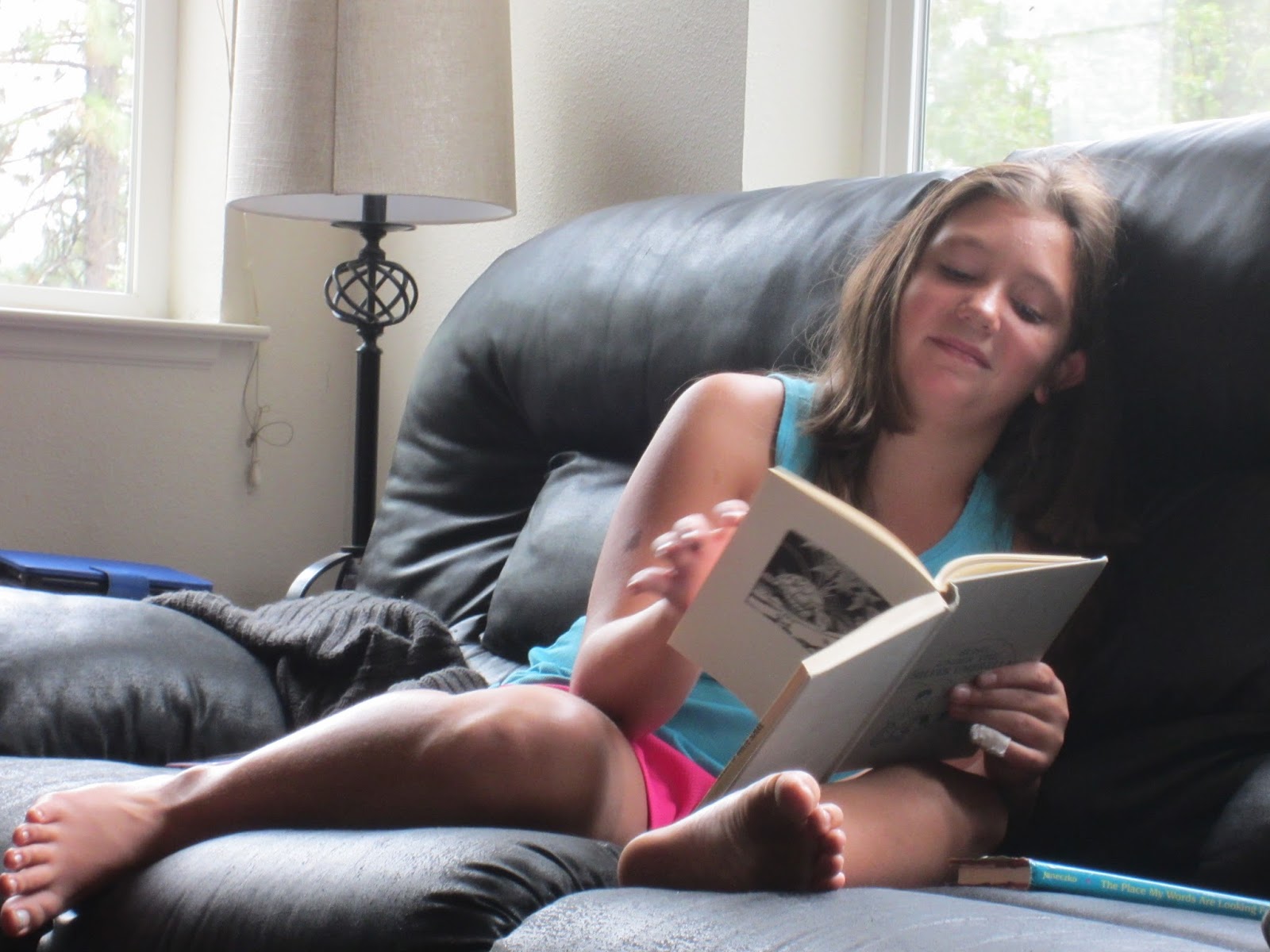
The lure of a book of poems

On this last visit, I took my elder granddaughter
Sung Under the Silver Umbrella,
a book of poems for children originally published in 1942,
and in several editions since. 
Many used copies are available on Amazon.
She likes it!
I forgot to check to see if it has one of my favorites, 
which is a children's counting-out rhyme or chant
which has been recorded in different forms. 


William Matrimmatoe
He's a good fisherman.
He catches hens,
Puts them in pens.
Some lay eggs.
Some lay none.
William Matrimmatoe
He's a good fisherman.
Wire, briar, limber, lock.
Three geese in a flock.
One flew east.
One flew west.
One flew over the cuckoo's nest.
Wire, briar, limber, lock.
Out goes you, old dirty dish rag, you.


I think is the "wire, briar, limber lock" that gets me!
For years, I thought "limberlock" was just one word. It sounds
like it should be!

Saturday, October 03, 2015

The Red Bird

This is one of the gifts I got for my birthday, from the grandchild I call
Little Red--because of the color of her hair. She knows I am a birder!
Note the beautiful repeated strokes of color on the bird.

I am suffering mildly from some sort of low-grade fever--an I-don't know what to do next, so why do this or that?--sort of fever. 

But, I am still reading (though only allowing myself to buy Kindle books, until I dispose of a few thousand paper ones!) and just began Mary Karr's new book (remember the big success of The Liar's Club?) The Art of Memoir.

Here is a quote from early in that book for this memory thread:

"There are traumatic memories that rise up unbidden and dwarf you where you stand. But there are also memories you dig for: you start with a clear fix on a tiny instant, and pick at every knot until a thin thread comes undone that you can follow back through the mind's labyrinth to other places." (Kindle location 340.)

Please excuse my recent absence. I hope I am back now. . .