Showing posts sorted by relevance for query transtromer. Sort by date Show all posts

Friday, March 27, 2015

Taking a Stance

Last night's post showed my father holding a baby in his arms in front 
of the houses on First Street in Scotia, where first our family grew.
That baby was my brother, Richard. Here, we have moved to the farm
and he demonstrates his sparring stance.
This picture is also very interesting to me because of the furniture 
I can see in it; my mother went to lots of farm sales for furniture. 
The large cabinet below the bellows hanging on the wall 
is a Victorian design called a Bonnetiere, because of the space
behind double doors at the top, where ladies could store their bonnets.
My father refinished this to the natural wood color; my brother Dave has it now.
Atop the Bonnetiere is a washbowl with a brown design, which
we later used in the front hall in Shaker Heights for incoming mail.
Robert wrote a poem about that called The Mail Bowl, which I must look for.
The heavy mahogany piece with the square mirror was cut in half by Dad. 
We hung the mirror in the hall, and kept boots and rubbers under the lid of the seat. 
My niece, Bethany, has it now, I think. 
Later, my father lifted the wide-sawn floorboards under Richard's feet. 
They were fastened with antique square-headed nails, which Mom made him save 
and straighten and use again on the floorboards, which he re-installed 
with the hundred-year-old boards turned over, unused side up.

Richard was the one of us who learned to play the piano well, 
although Susan did master Fir Elise. I have just learned that Tomas Transtromer,
one of my all-time favorite poets, has passed away. When a stroke robbed him of speech,
he gave his Nobel Prize lecture by playing music written for the left hand.

Leaflet

The silent rage scribbles on the wall inward.
Fruit trees in blossom, the cuckoo calls.
It's spring's narcosis, but the silent rage
paints its slogans backward in the garages.

We see all and nothing, but straight as periscopes
wielded by the underground's shy crew.
It's the war of the minutes. The blazing sun
stands above the hospital, sufferings's parking place.

We living nails hammered down in society!
One day we shall loosen from everything.
We shall feel death's air under our wings
and become milder and wilder than we ever were.

Tomas Transtromer

translated by Robin Fulton
The Great Enigma, New Directions, 2006, page 187.

Amazingly enough, this poem turns out to have both death and nails (probably not hand-forged ones) in it--after I picked it out.
Such are the things that happen when one plays with words. 
Look for Transtromer's poems, they are world-class!

Thursday, August 22, 2013

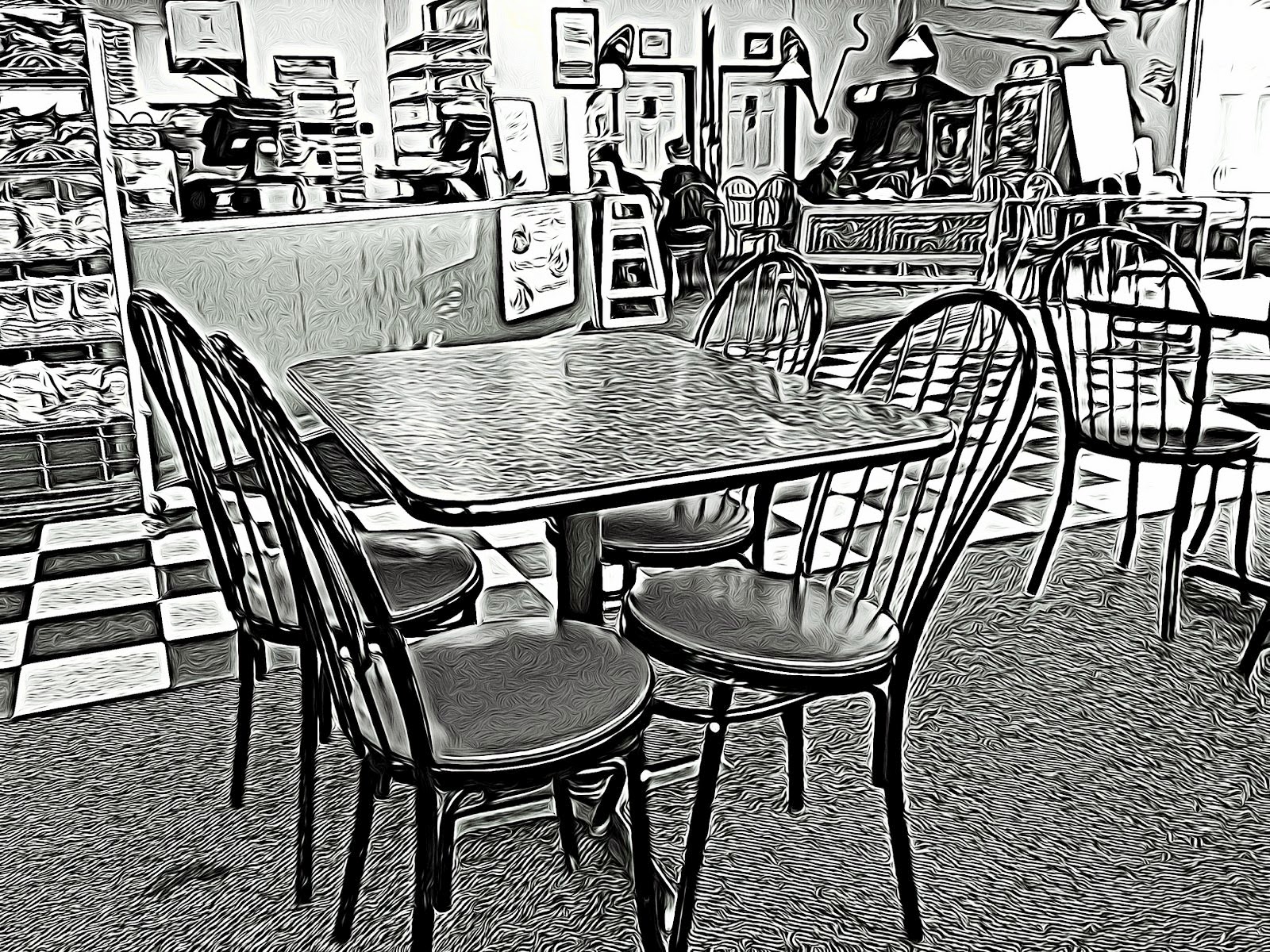
Inside another eatery


Lately I have found that snapshots inside pizza parlors or such places work beautifully with the app TangledFX and its black and white etching filter. I guess it is something about the chairs. This place is called Mancino's; it's in downtown Petoskey, Michigan.

Right now, the sun has just gone down just outside the big windows overlooking the meadow; the sky is suffused with that rosy glow. The opera channel is playing on satellite radio. All and all, a mellow evening.

I got out the Transtromer again today, and took it to bed with this cold. The book made me very happy, and it has been hard to pick just one for tonight.
[I just picked one, talked about it, and finished typing it when the laptop decided to do a Windows update, without any warning! and I lost all but the paragraph above. Can't overdo the crabbiness I felt, but here I am back for the re-do.]

The poem I have chosen in TRACKS by Tomas Transtromer, one of my favorite poets. It is on page 34 in The Great Enigma; new collected poems, translated from the Swedish by Robin Fulton.

TRACKS


2 AM: moonlight. The train has stopped
out in thw middle of the plain. Far away, points of light in a town, 
flickering coldly on the horizon.

As when someone has fallen into a dream so deep
he'll never remember having been there
when he comes back to his room.

As when someone has fallen into an illness so deep
everything his days were becomes a few flickering points, a swarm,
cold and tiny on the horizon,

The train is standing quite still.
2 AM: bright moon light, few stars.

---Tomas Transtromer

This is also, for me, a Memory Thread, since this was one of the three poems Robert Hass brought to our seminar to introduce us to the work of Transtromer. More than 30 years ago!!! I have loved the sensible and mysterious work of the Swedish poet ever since, and am glad to back here tonight. Sleep Well!


Sunday, April 21, 2013

"Things I've lived through here become visible on the walls"


Books of letters can sometimes make very good reading. This is the case with the two-poet volume I have on my Kindle right now.Airmail: the letters of Robert Bly and Tomas Transtromer. Just came out, also published in Swedish. Those letters of Virginia Woolf almost broke my heart, mostly about invitations for tea, or whatever, before I gave up. I found her diaries better reading. I am very interested in diaries and have a good many published ones, but they, too, are often hard going, This volume between Bly and Transtromer as they were discussing translations and becoming greater friends contains a lot of delightful stuff, including visits to the past that I also lived through, like the March on Washington. It is making me very happy. Here is something I found near the end. It is so lively and full of ideas! And the murals reminded me of the ones from Akrotiri that I saw in the Archeological museum in Athens. They, too, were so lively and fresh! I recently came across two letters from Sister Neal, who went to church with us when I was young. They were letters to my mother, thanking her for help, which Sister Neal (I found out from these letters that her name was Edith!) sent after we had moved to Ohio. Now that this sort of thing has become texts or email, the stamp, the handwriting, and the yearning across distances cannot be felt in the same way. The passage I quote below was written about the experience of moving. And the idea of our past becoming visible on the now blank walls is a poet's idea, from one of the best of them.

"III
"The apartment where I lived over half my life has to be cleaned out. It is already empty of everything. The anchor has let go—despite the continuing weight of grief it is the lightest apartment in the whole city. Truth doesn't need any furniture. My life has just completed a big circle and come back to its starting place: a room blown out. Things I've lived through here become visible on the walls like Egyptian paintings, murals from the inside of the grave chamber. But the scenes are growing fainter, because the light is getting too strong. The windows have got larger. The empty apartment is a large telescope held up to the sky. It is silent as a Quaker service. All you can hear are the doves in the backyard, their cooing."

The third section of Preludes.
Tomas Transtromer from Night Vision, translated by Robert Bly.


Posted by Picasa

Tuesday, October 01, 2013

Milkweed seedling with bare foot & rock border


I am sorry about last night; the internet failed me. I was finally able to send the sunset picture via the iPhone, and unlike all the other pictures it came out big. Don't know why. I think it qualifies as a post, so I am good for every day this year! When I tried to add text it didn't work; thus no poem. But it really was an amazing sunset with a huge deep-salmon-colored cloud.

This photo is the kind of thing I try when I am not photographing sunsets. I went out the other morning to photograph the dawn. After that I looked around for something else to do, besides going back to bed. Afterwards, I did go back to bed.

Milkweed seedlings lave been coming up all over all summer long; there have been several crops. They sprout in the paths, in the beds, in the proto-lawn. And still not a single Monarch butterfly.I guess it's tough when you are a bug that migrates over several generations, and your forest in Mexico is being cut or burned down.

Here is another passage from Transtromer's Baltics, which I discuss in a recent post. It's a wonderful book! One of the things I like about it is its specificity, At the end of the book, is the photographer's essay about how the photographs were taken at the Transtromer family's summer home over several generations. Her epigraph for her essay is taken from a Transtromer interview:, "...my poems always have a definite geographical starting point."  I am going to think more about this and work on locating some of my writing in particular places. Here is the passage. I never knew the monks had reached into these isolated Northern isles.

"August 3. Out there in the damp grass
slithers a greeting from the Middle Ages: Helix pomatia
the subtly gray-gold shining snail with its jaunty house.
Introduced by some monks who liked escargots--yes, the
       Franciscans were here,
broke stone and burnt lime, the island was theirs in 1288, a\
        donation from King Magnus
("Thes almes and othres he hath yeven / Thei meteth hym nu he
         entreth hevene.")
the forest fell, the ovens burned, the lime taken by sail
to the building of the monastery . . .
                                                  Sister snail
stands almost still in the grass, feelers sucked in
and rolled out, disturbances and hesitation . . .
How like myuself in my searching."

Tomas Transtromer, from Baltics,
translated from the Swedish by Samuel Charters, Tavern Books, 2012, page 51.

I love the bits of SPECIFIC information in this. I love books of poems with photos in them. I love Transtromer's poetry. And I love milkweed and the dawn. Good night.


Monday, February 18, 2013

A picture to go with imagined music, and a poem by Transtromer


My late blog-friend, Joann, had her blog fixed to play music while you read it. It was never music I particularly wanted to hear, mostly classic pop, but still it was fun. I would like to have a piece of classical music that went with this photo. Maybe "The Swan of Tuonela," by Sibelius. I still have the 10-inch long-play record the parting gift of my first real boyfriend, distant cousin Gale Holladay.

But here instead is a poem by that master poet, Tomas Transtromer. He plays the piano, and because of a cerebral accident lost the power to speak. So at the Nobel Awards, he played the piano with the hand that was left to him--instead of making the usual speech. I find this very moving and brave. He has been one of my very favorite poets for more than twenty years, since Robert Hass introduced him to us in our class.

AS WHEN YOU WERE A CHILD

As when you were achild and some tremendous hurt
was pulled over your head like a sack---
glints of sunlight through the mesh
and the hum of the cherry trees.

But it doesn't help, the great hurt
covers head and torso and knees
and though you are able to move sometimes
spring brings no happiness.

Yes, shimmering wool cap, pull it down over your face
stare through the mesh.
Out on the bay, the rings of water multiply soundlessly.
Green leaves darken the earth.

poem by Tomas Transtromer
from For the Living and the Dead, page 49.

Late last night I was reading a Kindled book: How Faulkner became Faulkner.
I read the part about the emotional dynamics of his family. And again, the early
childhood traumas came up. (And the issue of twinship, in a novel, not in his life.)
More on this later. It is amazing how I am finding this in so many places recently.
I'll try to expand on this tomorrow.  Good Night.
Posted by Picasa

Saturday, September 06, 2014

The red, red maple


Not yet; this was last year's October. I saw this tree growing with another when it wasn't as tall as I was. Because it was such a beautiful color, I cut the other one away years ago. Now this red beauty is really shooting up and will soon be taller than the Scotch pine it grew up under. The young maple sprouted at the edge of a large cobble, which now rests on its foot-root.

How the Late Autumn Night Novel Begins

The ferry-boat smells of oil and something rattles all the time like an obsession. The spotlight's turned on. We're pulling in to the jetty. I'm the only one who wants off here. "Need the gangway?" No. I take a long tottering stride right into the night and stand on the jetty, on the island. I feel wet and unwieldy, a butterfly just crept out of its cocoon, the plastic bags in each hand are misshapen wings. I turn round and see the boat gliding away with its shining windows, then grope my way towards the familiar house which has been empty for so long. There's no one in any of the houses round about... It's good to fall asleep here. I lie on my back and don't know if I'm asleep or awake. Some books I've read pass by like old sailing ships on their way to the Bermuda triangle to vanish without a trace... .I hear a hollow sound, an absentminded drumming. An object the wind keeps knocking against something the earth holds still. If the night is not just an absence of light, if the night really is something, then it's that sound. Stethoscope noises from a slow heart, it beats, goes silent for a time, comes back. As if the creature were moving in a zigzag across the Frontier. Or someone knocking in a wall, someone who belongs to the other world but was left behind here, knocking, wanting back. Too late. Couldn't get down there, couldn't get up there, couldn't get aboard... The other world is this world too. Next morning I see a sizzling golden-brown branch. A crawling stack of roots. Stones with faces. The forest is full of abandoned monsters which I love.

Tomas Transtromer
The Great Enigma; new collected poems, 
translated by Robin Fulton, New Directions, 2006

I can still remember the night Robert Hass brought the poems of Tomas Transtromer to the evening poetry seminar at San Jose State. Knocked, as they say, my socks off! I've been nuts about Transtromer ever since; just nuts!

And afterward I wrote a prose poem for class, which, since it took place on the Santa Cruz Boardwalk in the daytime I called: "How the Late Autumn Novel Begins." I just found a copy of this poem, which I had stored in "the cloud" and I still like it enough to send it out. Although I ought to just post it here and not wait for the Sixth Extinction. But I am too tired to decide, having just finished preliminary work on our haiku anthology--so proud of myself.


Friday, July 11, 2014

Flotilla of mallards under the willow


Burley finished up today. Finding him to do this cleanup has been a real blessing. He has taken four trailer loads to the dump for compostables. Leaves, branches, dead limbs, cattails, cottonwood sucker-shoots, weeds of all descriptions. This willow had more dead branches than living ones. The ducks love it under the willow; look for them on the far side of the stream. And the willow is already beginning to put out new shoots  toward us from the parts trimmed a couple of weeks ago. I've just spent the better part of blog-hour resolving lost Internet connectivity. No matter how many times it happens, it is always shocking to see "this device is not connected to the Internet" on the screen.

Here is a Transtromer poem I have been saving since last year, when I left this book behind. Perhaps it will remind me that I haven't packed up that package to mail to my brother yet.

Airmail

On the hunt for a letterbox
I took the letter through the city.
In the great forest of stone and concrete
fluttered the straying butterfly.

The postage-stamps flying carpet
the swaying lines of the address
added to my sealed-in truth
right now floating above the ocean.

The Atlantic's creeping silver.
The cloud-banks, the fishing boat
like a spat-out olive stone.
And the keel-wakes' pallid scars.

Here below the work goes slowly.
I often glance toward the clock.
The tree-shadows are black numerals
in the avaricious silence.

The truth is to be found on the ground
but no-one ventures to carry it off.
The truth is lying on the street.
No one makes it his own.

Tomas Transtromer, from Inspired Notes;
Poems of Tomas Transtromer, translated by John F. Deane.
Dedalus Press, 2011, page 64.


Tuesday, January 14, 2014

The Bravest Duckling


When Mrs.Mallard brought her ducklings up to visit last spring, this little one was the only one who ventured inside the patio railing. By now he or she will be all grown up and perhaps was one of the mallards that enjoyed my cracked corn recently. I am especially fond of the lavender touch that showed up on his feet when I lightened the underexposed picture.

I have Tomas Transtromer's The Great Enigma, translated by Robin Fulton on my Kindle, and because of this poem, I need to find out how many ducks (about) live on the Earth just now. I know there are more people, but the poem was written a few decades ago.


Dream Seminar

Four thousand million on Earth.
They all sleep, they all dream.
Faces throng, and bodies, in each dream--
the dreamt-of people are more numerous
than us. But take no space . . . .
You doze off at the theater perhaps,
in mid-play your eyelids sink.
A fleeting double exposure: the stage
before you outmaneuvered by a dream.
Then no more stage, it's you.
The theatre in the honest depths!
The mystery of the overworked director!
Perpetual memorizing of new plays . . .
A bedroom. Night.
The darkened sky is flowing through the room.
The book that someone fell asleep from lies
still open
sprawling wounded at the edge of the bed.
The sleeper's eyes are moving,
they're following the text without letters
in another book--
illuminated, old-fashioned, swift.
A dizzying commedia inscribed
within the eyelids' monastery walls.
A unique copy. Here, this very moment.
In the morning, wiped out.
The mystery of the great waste!
Annihilation. As when suspicious men
in uniforms stop the tourist--
open his camera, unwind the film
and let the daylight kill the picture:
thus dreams are blackened by the light of day.
Annihilated or just invisible?
There is a kind of out-of-sight dreaming
that never stops. Light for other eyes.
A zone where creeping thoughts learn to walk
Faces and forms regrouped.
We're moving on a street, among people
in blazing sun.
But just as many--maybe more--
we don't see
are in dark buildings,
high on both sides.
Sometimes one of them comes to the window
and glances down on us.

--Tomas Transtromer

I love the imaginative and surprising, yet clear, leaps in this poem! I love the Transtromer imagination! I like the varied line-lengths, too. It makes me wish again that I knew Swedish!

Monday, March 14, 2016

Four Family Friends

These four people were a very important part of my childhood in the 1940s. Both couples lived in Scotia, N.Y. The Leighs lived in the house next door, (which we had rented before we bought 316 First Street) and the Hansens lived down the street. (I remember being impressed by their thrift (and the way they spent 
easy time together) when my mother told me 
that they took an evening walk together 
to the library to read the newspaper, 
thus saving the cost of a subscription.  
We all went to church together every Sunday, 
first to the LDS Branch in Albany 
and later to the Schenectady LDS Branch.

Left to right, Henry Leigh, Joan Cooley Leigh (originally from Bountiful, Utah) Evelynn Sylvester Hansen (originally from Southern Utah near Monroe) and Burns Hansen. 
My mother probably took the slide,
perhaps in Utah, in a house I do not recognize.

The men were young engineers who had come east 
to Schenectady to work for General Electric, like my father. 
Both couples transferred back to Utah after several years, 
but we kept in lifelong touch, 
and visited whenever we could. 

The man in the white shirt is Burns Hansen, my first love.
His kind attention was ever available; I never saw him lose
his temper or even get annoyed. I planned to look 
for a husband just like him, since he was already taken.

Skating Backwards 
is also the title of my poetry manuscript in progress.


KYRIE

Sometimes my life opened its eyes in the dark.
A feeling as if crowds moved through the streets
in blindness and angst on the way to a miracle
while I, invisible, remain standing still.

Like the child who falls asleep afraid
listening to his heart's heavy steps.
Long, long until morning slips its rays in the locks
and the doors of darkness open.

Tomas Transtromer
                                        translated by Patty Crane

Bright Scythe: 
Selected Poems of Tomas Transtromer; translated by Patty Crane.  (Kindle location 230)

The feeling-tone of this poem is not synchronous with my memories of the people in the picture. At that Scotia time I never fell asleep afraid; I had a blessed childhood, really. 

I love the work of Transtromer, and was very glad to see these new translations (with the Swedish originals on the facing pages, which are wonderful to examine!) by a new translator who has selected poems from all parts of his long career.

I have missed doing this blog and hopefully will resume now. 

Thursday, November 21, 2013

Verdant Memory


"Another wood, the bright one." Deer, grasses, maple, spruce. Mid-August.
I think this doe can see me taking pictures through the window.

On the Daily Walk today, it was very, very cold with some wind. How quickly the summer was gone! I did manage to finish Dark Visions, the first volume of Coleridge's biography by Richard Holmes. And I've taken a tiny start at Volume Two. I keep wishing to tell Coleridge to lay off the laudanum, but it is 200 years too late. The first book ends with the beginning of his voyage to Gibraltar in April, 1804. The second volume begins with the voyage; he has to share the cabin with a drunken Lieutenant on half pay and a merry fat lady. He measured his bunk and it was 20 inches wide! I guess I prefer the way we do things now.

[Aside: S's laptop (the power plug slips, but not all the way out) just told him to "plug in or find another power choice."
"Like what," he screams, "a waterwheel.??"]

And here, to go with this verdant photograph is Tomas Transtromer's Madrigal. It is in Inspired Notes; poems of Tomas Transtromer translated by John F. Deane, page 65.

Madrigal

I inherited a dark wood to which I seldom go. But a day
will come when the dead and the living change places.
Then the wood will begin to stir. We are not without
hope. The most serious crimes remain unsolved despite
the efforts of many policemen. In the same way there
exists, somewhere in our lives, a great love, unsolved. I
inherited a dark wood but today I am going into another 
wood, the bright one. Every living thing that sings,
wriggles, oscillates and crawls! It is spring and the air is 
very strong. I have a degree from oblivion's university
and am as emptyhanded as the shirt on the clothesline.

Tomas Transtromer

It interests me that this is a prose poem, but that some of the linebreaks, which I have reproduced, are still very interesting. S. doesn't think there is any such thing as a prose poem. . . I like them, but I do so appreciate the way the music is enhanced by good linebreaks. Spellcheck doesn't like "linebreak" or "spellcheck" either, but I am a BIG FAN of compounded words, especially in poems.
It is after midnight now and frost crystals cover the ground in Eagle, Idaho, named for the bird. Fly to bed!


Posted by Picasa

Sunday, April 05, 2015

Spring's Narcosis

Lupine on the dunes at Monterey Bay in the beautiful light near the sea.
Far away in Idaho, tulips and daffodils and the tiny grape hyacinths that still poke through
though they have been replaced by lawn remind me about the flowering dunes.
  
Leaflet

Silent fury scribbles inward on the wall.
Fruit-trees in blossom, the cuckoo calls.
It is spring's narcosis. But silent fury
paints its slogans backward in the garage.

We see everything and nothing, but straight as periscopes
handled by the shy crew from underground.
It's the minutes' war. The blazing sun
stands over the hospital, suffering's parking place.

We living nails hammered down into society!
One day we will come loose from everything.
We will know death's air under our wings
and grow milder and wilder than we are here.

Tomas Transtromer 
Inspired Notes; Poems of Tomas Transtromer, 
translated by John F. Deane, Dedalus Press, 2011, page 54.

I've come back once again to the rich poems of Transtromer, introduced to me in class so many years ago by poet Robert Hass. It is probably too late for me to learn Swedish, so I am lucky that translations of at least some of his work are available, and there may be more, since he won the Nobel Prize! He died this year, in March. Many years ago I had the good fortune to hear him read in a church in San Jose. He stood behind a lectern carved with a great eagle or hawk facing us. For me that carved eagle is indelibly associated with his persona.

Saturday, June 07, 2014

Painting the Barn White


Here ia another of my mother's slides from, perhaps, the summer of 1956. The barn hasn't been painted for a long time (ever?) and is soaking up the paint. The house was built between 1860 and 1870 and the barns must have some later. I looked them up on Google Earth (from the air!) and it looks like one of the barns (there were of them, placed in an L-shape) has been torn down. I did a lot of painting, too, before I left home in rural New York State to attend the alma mater of my parents, the University of Arizona. I painted the clapboards of the addition to the house (one coat of linseed oil, two coats of white paint) for $1 per hour, which I saved for college. The year before I had painted the metal roof of the house, one section at a time. I've been telling the story of what we call The Farm in this blog over many posts. To find them put "the farm" in the search box at the upper left.

Far away in Scandinavia, a nightingale is singing in this poem by Tomas Transtromer. Like this blog, this poem is also about time and memory. Unluckily, I haven't been able to find anything about Badelunba.

The Nightingale in Badelunba

In the green midnight at the nightingale's northern boundary. Heavy leaves hang in a trance, the deaf motorcars rush toward the neon-line. The voice of the nightingale does not step aside, it is as penetrating as the crowing of a cock, but lovely, and without vanity. I was in prison and it visited me. I was sick and it visited me. I wasn't aware of it then, but I am now. Time streams down from sun and moon and into all the tick-tock, tick-tock-thankful clocks. But just here no time exists. Except for the voice of the nightingale, the raw resounding tones that hone the pallid scythe of the night sky.

Tomas Transtromer, from Inspired Notes; poems of Tomas Transtromer, translated by John F. Deane, Dedalus Press (Irelnad) 2011, page 47.

Write a paragraph-poem about time, memory, birdsong and/or the distant past. Try to coin some hyphenated words like "neon-line" or "tick-tock-thankful." And sleep well!


Friday, February 14, 2014

Nosegay


This little bouquet was prepared for a bookmaking and sketching class I took last summer. Whenever I see a very small bouquet, I remember Beth Fletcher. She was a friend I made when I worked at the Gilroy Library. She used to bring me her old New Yorker Magazines and might be responsible for teaching me to love that magazine the way I still do. The library didn't take that magazine then, Once, when someone came to visit her, she brought them into the library to meet me and told her I was "the smartest woman in Gilroy" which was a very nice compliment, I thought, even if exaggerated.

During spring and summer, when things were in bloom in her garden, she usually brought me what she called a "nosegay" a small bouquet of mixed flowers from her garden. These were less than three inches across and required a small vase. The signature thing that she did was to bind the stems of her arrangement by wrapping them (round and rounda) with a flexible stem from Asparagus sprengari, the type of asparagus fern that also grew in her garden. I have a plant of this now, and whenever I weed around it, I remember Beth, who died many years ago. That's tonight's memory thread.


“Schubertiana”

by Tomas Transtromer. (Trans. Kalle Raisanen)

I.

In the evening-dark of a place outside New York, a look-out point

where one glance can encompass eight million people’s homes.

The giant city over there is a long, flickering snow-drift, a spiral

galaxy on its side.

Inside the galaxy, coffee cups are slid over the counter, store-fronts

beg with passers-by, a crowd of shoes that leave no traces.

The climbing fire-escapes, the elevator doors gliding shut, behind

locked doors a constant swell of voices.

Sunken bodies half-sleep in the subway cars, the rushing catacombs.

I know, also — statistics aside — that right now Schubert is

being played in some room over there and that to someone

those sounds are more important than all those other things.

I I.

The human brain’s endless expanse crumpled into the size of a fist.

In April, the swallow returns to its last-year’s-nest under the roof

of that very barn in that very parish.

She flies from the Transvaal, passes the equator, flies for six weeks

over two continents, steers toward this disappearing point in 

the land-mass.

And the man who captures the signals of a whole life in some

fairly ordinary chords by five strings

the man who makes a river run through the eye of a needle

is a fat young man from Vienna, called “Little Mushroom” by his

friends, who slept with his glasses on

and got punctually behind his writing desk each morning.

At which the wonderful centipedes of music were set in motion.

I I I.

The five strings play. I walk home through tepid forests with the

ground springing under me

crawl up like an unborn, fall asleep, roll weightless into the future,

suddenly feel that the plants have thoughts.

IV.

So much we have to trust, simply to live through our daily day

without sinking through the earth!

Trust the snow clinging to the mountain slope over the village.

Trust the promises of silence and smiles of understanding,

trust that the accident telegram isn’t for us and that the sudden

axe-blow from within won’t come.

Trust the wheel-axles that carry us on the highway in the middle

of the three-hundred-times magnified bee swarm of steel.

But none of that is really worth our confidence.

The five strings say we can trust something else.

Trust what? Something else, and they follow us part of the way there.

As when the lights turn off in the stair-well and the hand follows

— with confidence — the blind handrail that finds its way in

the dark.

V.

We crowd in front of the piano and play four-handed in F-minor,

two coachmen on the same carriage, it looks slightly ridiculous.

Our hands seem to move clanging weights back and forth, as if

we were touching the counter-weights

in attempt at disturbing the terrible balance of the great scales:

joy and suffering weigh exactly the same.

Annie said, “This music is so heroic,” and it’s true.

But those who glance enviously at the men of action, those who

secretely despise themselves for not being murderers

they don’t recognise themselves here.

And those many who buy and sell people and think that everyone

can be bought, they don’t recognise themselves here.

Not their music. The long melody that remains itself through all

changes, sometimes glittering and weak, sometimes rough and

strong, snail-trails and steel wire.

The insistent humming that follows us right now

up the

depths. 


This has been one of my very favorite poems for many years; I have read it in several translations and was surprised in some ways by this one. The work of Transtromer has made me really wish I knew Swedish! The linebreaks on such long lines are hard to represent, both here and in print. But the short lines in the end are meant, I am sure, to slow you down at the end. The poem covers a great deal of territory, but in a much more detailed way than last night's poem. Think about the strengths of each approach. And kiss yourself good night with some of the music of that "fat young man from Vienna." Good night!

Sunday, December 01, 2013

Thinking about planning


Well, I notice this is December First and if I am to write one haiku every day in December I have another quarter-hour to do so. But first, this. I was thinking about painting Christmas greetings, a few years back, but found I really like photographs better. But this watercolor has a certain riotous quality I like.

Turkey soup--
she keeps asking me what
I want for Christmas

There, only 30 haiku to go. Still thinking about a resolve for next year. It should probably be something about the body. But I am thinking about a sketch a day. Tonight I found a cute little sewing machine on Craigslist, and have sent owner an email, There are TONS of sewing machines on Craigslist in case that doesn't pan out and the prices are much better than on eBay. While I was there I looked at some sets of china that people had inherited from grandmothers. One family even had grandmothers from both sides and a great-grandmother. It made me a little sad looking at all these dishes that were saved for later. Most sets were complete with no signs of wear. Only one had a lot of broken pieces. Many patterns were tiny florals in washed out colors. It definitely made me sad, like a metaphor for the passing of time.

In the perfect, perfectly small book INSPIRED NOTES; poems of Tomas Transtromer,
tramslated by John F. Deane, I found this winter poem from Sweden on pages 45 and 46.
Here is your link about Svalbard; it's very far NORTH.

Six Winters


1
In the dark hotel a child is sleeping.
Outside: the winter night
where the great-eyed dice are rolling.

2
An elite of the petrified dead
in Katarina Churchyard
where the wind shivers in its armour from Svalbard.

3
A winter of war where I lay ill
grew an immense icicle outside the window.
Neighbour and harpoon, memory without explanation.

4
Ice hangs down from the edge of the roof.
Icicles: the Gothic, turned upside down.
Abstract cattle, udders of glass.

5
On a side track an empty railway wagon.
Still. Heraldic.
Journeys in its claws.

6
Night snowhaze, moonlight. The jellyfish of the moon
floats above us. Out smiles
as we head homeward. Avenue bewitched.

                     ---Tomas Transtromer (Nobel Prize for Literature, 2011)

There is enough in this short poem to think about for weeks. Slow down and take it a phrase at a time. The icicles, the railway car, the moonlight and the cold, cold, cold. I hope to catch something very wintery in the December haiku I hope to write. And now to bed on the first night of the last month of this 21st Century year. Sleep tight; sleep warm.


Sunday, August 25, 2013

Morning Light, Evening Lght


ASPENS AND BRACKEN
All day long these aspen leaves quiver in the changing light. Today has been mostly about weather. I finally did some watering of wilting perennials, and was rewarded by a brief, but splendid rainstorm, It has been so dry this year that it needs to rain for DAYS, but this was very welcome.

Joseph Mallord William Turner, (1775-1851)the great English painter, loved weather and made many sketches and paintings of clouds and sunsets.


CLOUDS TO THE WEST, THE GREAT BOWL OF SKY fills with the last of today's sunlight.

Here, as promised last night, is another Transtromer poem, with some of the mystery left in.

A SKETCH FROM 1844


William Turner's face is weather-brown.
He has set up his easel far out among the breakers.
We follow the silver-green cable down in the depths.

He wades out in the shelving kingdom of death.
A train rolls in. Come closer.
Rain, rain travels over us.

Tomas Transtromer from The Great Enigma; new collected poems, translated from the Swedish by Robin Fulton. Page 214.


CLOUDS TO THE EAST, REFLECTED SUNSET tints the clouds pink tonight. I love pink! And I take too many pictures of clouds. However, I console myself by remembering that the great photographer, Edward Steichen (1879-1973) took many pictures of clouds from the roof of his New York abode. And he had to pay for film! Sleep well, and dream of rain.

Saturday, February 22, 2014

Memories Look at Me


This is my grandson, talking to me on Face Time. That's me in the upper right corner, the way he sees me, with himself in the upper corner. Sometimes I get impatient with all this technology, but this was fun! So here, from the wrong season entirely, a Transtromer poem about memory.


Memories Look at Me

A June morning, too soon to wake,
too late to fall asleep again.

I must go out -- the greenery is dense
with memories, they follow me with their gaze.

They can't been seen, they merge completely with
the background, true chameleons.

They are so close that I can hear them breathe
although the birdsong here is deafening.

Tomas Transtromer 
in New Collected Poems; translated by Robin Fulton, Bloodaxe Books, 1997, page 135.

Why do I love the work of this poet so much? All the birds in his work don't hurt. But I think it is the surprising upwelling of wonderful metaphorical thought.

Tuesday, October 22, 2013

Afternoon light on Silverwood Way


This is the welcome sight when we got here. The ducks came by a few minutes after I came out to take this photo. I'm out of cracked corn, but will replenish very soon. It is wonderful to be here at last, even after the special BIG SKY beauties of North Dakota and Montana in the last few days.This photo is a simple view of the sun on the lawn through trees. Tonight's poem is not quite that simple, but I think it repays careful attention. It's by a favorite poet of mine, Tomas Transtromer, whose work (in translation) I have loved ever since Bob Hass introduced him to our poetry class in the early 1980s. It is found on pages 50-51 of the slender book, INSPIRED NOTES; poems of Tomas Transtromer, translated by John F. Deane, which was published by Dedalus Press, Dublin, Ireland.

Shanghai Streets


The white butterfly in the park is being read by many.
      I love this cabbage butterfly as if it were a fluttering
      corner of truth itself.

At dawn the running crowds jump-start our silent planet.
Then the park fills up with people. Each one with eight
      faces polished like jade, for every situation, for
      avoiding blunders.
Each one also with the invisible face that reflects
      "something not to be mentioned."
Something that emerges in weary moments and is rank
      as a draught of viper brandy with its lasting scaly
      aftertaste!

The carp in the pond perpetually move, they swim even
      while they sleep, they are models for the faithful:
      always in motion.

2.

Now it is mid-day. Laundry is fluttering in the grey sea
      winds high above the cyclists
who come in tight shoals. Watch out for the labyrinths
      off to either side!

I am surrounded by written characters I can't decipher,
     I am totally illiterate.
But I have paid as I ought and have receipts for
      everything.
I have collected about me so many illegible receipts.
I am an old tree with withered leaves that are hanging
      on intact and cannot fall to the ground.

And a breath from the sea causes all these receipts to
     rustle.

                                        * * * * * *

I love the way this poem moves! I like the arrangement on the page, and the little narratives which expand, like the one about the receipts. I like the setting and I love the nature images. I particularly love the swift movement of the poem through so many human quandaries. I love the way the poet is present and becomes even more so in the last parts. It makes me want to stretch and stretch my imagination.

Tonight, through the magic of Netflix, my son showed us a documentary on twin boxers from Los Angeles. Boxing is hard work and I am not sure that the effort is well spent. I will have to work on why. There isn't much of a place for women, although in one of the final important bouts, the referee was a tall woman who looked like the actress who used to play Maud on the TV show. She was wearing a fitted white shirtwaist with belted slacks. It struck me funny, although I am sure she would have been insulted to hear me say so. In this competitive, violent, sweating world, there seemed very little time for reading or poetry. I would not be at home there, even if I had receipts for everything.
Sleep well.

Posted by Picasa

Thursday, September 19, 2013

My mother photographs a winter tree, circa 1954

Sometimes, back in the world of developed and printed pictures before he left home, my eldest son would flip through the 36 shots--flip, flip, flip-- saying, "Where are the people?" It has never occurred to me until recently that I might have learned most of my ideas about what it would be fun to photograph (No lining up, no saying "CHEESE" no bossiness from the photographer. Just take pictures of what IS and maybe move a little closer or to one side.)

This is is one of the windows that my mother made by accretion in a photo I took on a visit to Shaker Heights. Now I wish I had lined it up a little better. I just had a lot of my mother's slides scanned and I am very glad I did. This tree is one of them, but most of them DO have people.

Here in Northern Michigan, we had frost a couple of nights ago that turned the leaves of the tomato plants in daughter K's garden translucent.  And now the maple leaves are just beginning to turn. So it really is true: winter is coming..

As a Swedish poet and person, Tomas Transtromer is well acquainted with winter. He has also been on this blog before! This is because he is an essential poet for me. I was so glad when he got the Nobel Prize for poetry in 2011!

BELOW FREEZING


We are at a party that doesn't love us. Finally the party lets
the mask fall and show what it is: a shunting station for
freight cars. In the fog cold giants stand on their tracks. A
scribble of chalk on cardoors..
   One can't say it aloud but there is a lot of repressed
violence here. That is why the furnishings seem so heavy.
And why it is so difficult to see the other thing present: a
spot of sun that moves over the house walls and slips over
the unaware forest of flickering faces, a biblical saying
never set down: " Come unto me, for I am as full of
contradictions as you."
   I work the next morning somewhere else. I drive there in
a hum through the dawning hour which resembles a dark
blue cylinder. Orion hangs over the frost. Children stand
in a silent clump, waiting for the schoolbus, the children
no one prays for. The light grows as gradually as our hair.

Tomas Transtromer, translated by Robert Bly from Truth Barriers, Sierra Club Books, 1980, page 32.

The motion of this poem is astonishing and natural (at the same time) to me. It includes individual life and worries, concern for others, the natural world, the iron world of machinery and modern life and so much more. I love the unexpected and wonderful shifting here. Read it over again, out loud! And sleep well.


Posted by Picasa

Saturday, February 23, 2013

Eroded Graves in Grafton, Southern Utah


I found this dry cemetery very moving when my brother, David, took me there after our Southern Utah family reunion. Below these mighty rocks lie the careful interments of Mormon pioneers. The wind seems to be taking away the earth around the gravemounds.
Slowly, slowly.
In that brief immersion in family history I noticed how small their remaining houses were, and how limited the things anyone could see, do, possess were.

Below is the first half of Transtromer's Eight Haiku;
to accompany this bleak desert graveyard.
Tomas Transtromer, The Living and the Dead,
Harper Collins, 1995, p. 62


Power lines
taut in the kingdom of cold
north of all music.

The white sun
practices long distance running
against death's blue mountain

We must live
with the small print of the grass
and the cellar laughter.

The sun is low now.
The shadows are giants.
Soon all will be shadow.

Posted by Picasa

Saturday, September 21, 2013

Photo Chart of Olga's Ancestors


A single click on this picture will enlarge it; otherwise it is pretty difficult to see.

That's my Mom on the left. It used to be the fashion, among Mormon genealogists, to create an 8 1/2 by 14 inch looseleaf book to keep track of the ancestors. Printed sheets were available to fill in with the names and dates. The slots were numbered and when you ran out of space, you took the last persons and started a numbered sheet for each of them. And so on. Our book was about three inches thick and also contained typescripts of pioneer reminiscences. Mom took the book apart later on for other projects, As you can guess, even from this chart, she usually kept working on things until neatness was lost.

This is a scan of a photocopy (I have no idea where the original is) of a picture chart that Mom made for our book. As you can see, there is only room for a few generations back on a page; in this case it correlates well with the birth of photography. The outline on the right was taken from a silhouette. And the guy under the silhouette is a photo of a statue! For some of these people, there is no extant likeness, or only this one. I would love to see copies of similar charts from other families, if you know of them. If you would be willing to share one with me, send me a message. I know at least one story about most of the people on this chart (just ask me!) and a photo or likeness is a really nice hook to hang one's information on.

There are no direct descendants of Edvard Grieg (although there are pictures in Wikipedia) since his only child died very young of meningitis. This poem is for anyone who loves his music! Or who loves poems that are funny and serious at the same time. From a poet who has been one of my top favorites for 30 years. They finally got around to giving Transtromer the Nobel Prize for Poetry in 2011!

AN ARTIST IN THE NORTH

I, Edvard Grieg, moved free among men.
I joked a lot, read the papers, often on tour.
I conducted the orchestra.
The auditorium and its lights shuddered with each triumph
                            like a train ferry pushing in to dock.

I have holed myself up here to butt heads with silence.
My work hut is small.
The grand piano fits as rubbing-tight in here as a swallow
                             under a roof shingle.

The steep and lovely mountain slopes are silent most of the time.
There is no path
but there is a wicket that sometimes opens
and a peculiar light leaks in directly from the trolls.

Simplify!

And hammer blows in the mountain came
came
came
came one spring night into our room
disguised as heartbeats.

The year before I die I shall send out four hymns
                              to track down God.
But it begins here.
A song about that which is near.

That which is near.

Battlegrounds within us
where we Bones of the Dead
fight to come alive.

Tomas Transtromer, translated from the Swedish by May Swenson with Leif Sjoberg  in Windows and Stones; Selected Poems, pages 29-30.

Try writing a poem in the voice of a musician. Since you will have to translate that into words, you will get a different kind of poem than if you wrote about a writer. Or you could write about Rebecca Thorne at the top right in the lovely frilly cap. The Bones of the dead will appreciate it.