Tuesday, July 09, 2013

A Memory Swan

Back in ancient times, when I sometime used the new roll of color film this developing outift used to send me whenever they developed and printed a roll, I stopped on the path when I saw the swan, and waited for him to swim away from the foliage, so I could get the reflection. Some of my friends that were on the ginko (walk for the purpose of composing haiku) told me to hurry up and rejoin the group.
This lone photo from the 1980s turned up last year when I was going through some papers. I have no idea what other photos I took that day, or what haiku I wrote. But the feeling of seeing a sudden swan on the water, surrounded by foliage in dappled light is still quite clear. Because of the odd film and the intervening years, the colors in this print are not true to nature. But I like the muted, somewhat limited and subtle palette of toned-down color. There is an iPhone program from Adobe that takes the main colors from a photo and turns them into a set of color blocks, like paint chips. I'd like to try that on this picture. I think I would see some deep greens, some brighter greens, some muted blues and a quite a bit of a sort of light tan, with a lot of almost-black, and just a trace of something reddish near the top,

Lately I have been looking at a blog called My Scandinavian Home. What seems to tie the homes together (it's not just one, but a lot of different homes, sort of like decorator pornography) is that they are ALL WHITE! They might have some wooden furniture, or some black accents, but the walls, drapes, floors and much of the furniture is white, white, white. It's oddly beautiful and compelling and sort of scary. Need I add, there is NO CLUTTER (and not much evidence of actual human life. . .) and I don't see any books. But these spaces are very beautiful, and I sort of wish I could . . . etc.

Tonight's poem, naturally, is from A Bird Black as the Sun; California Poets on Crows and Ravens,  Green Poet Press, Santa Barbara, 2011. Maybe, later, I can find (or make) a white bird book, for quick reference..

KNOWING

She said she would return
as a crow,
swarm on the spiked branches
of Monterey pines
with others in her flock
Not some regal raven,
but a so-so black bird

In life, she dressed
in peacock feathers
and amethyst beads
Now she'll hover,
a dark phantasm

Perhaps in the long days
of her dying
she kenned
an elegant coherence
in the world
black silhouette
against almond sky.

Charan Sue Wollard, page 128

The form is three stanzas of 7, 5, and 7 lines. I don't see syllabics, or a metrical pattern. And of course, the word I wanted above for the tan color is "almond," If you could return as a bird, what bird would you be?
Good night! And in your dreams, try to fly!
Posted by Picasa

Monday, July 08, 2013

In Alanson, it is Summertime!


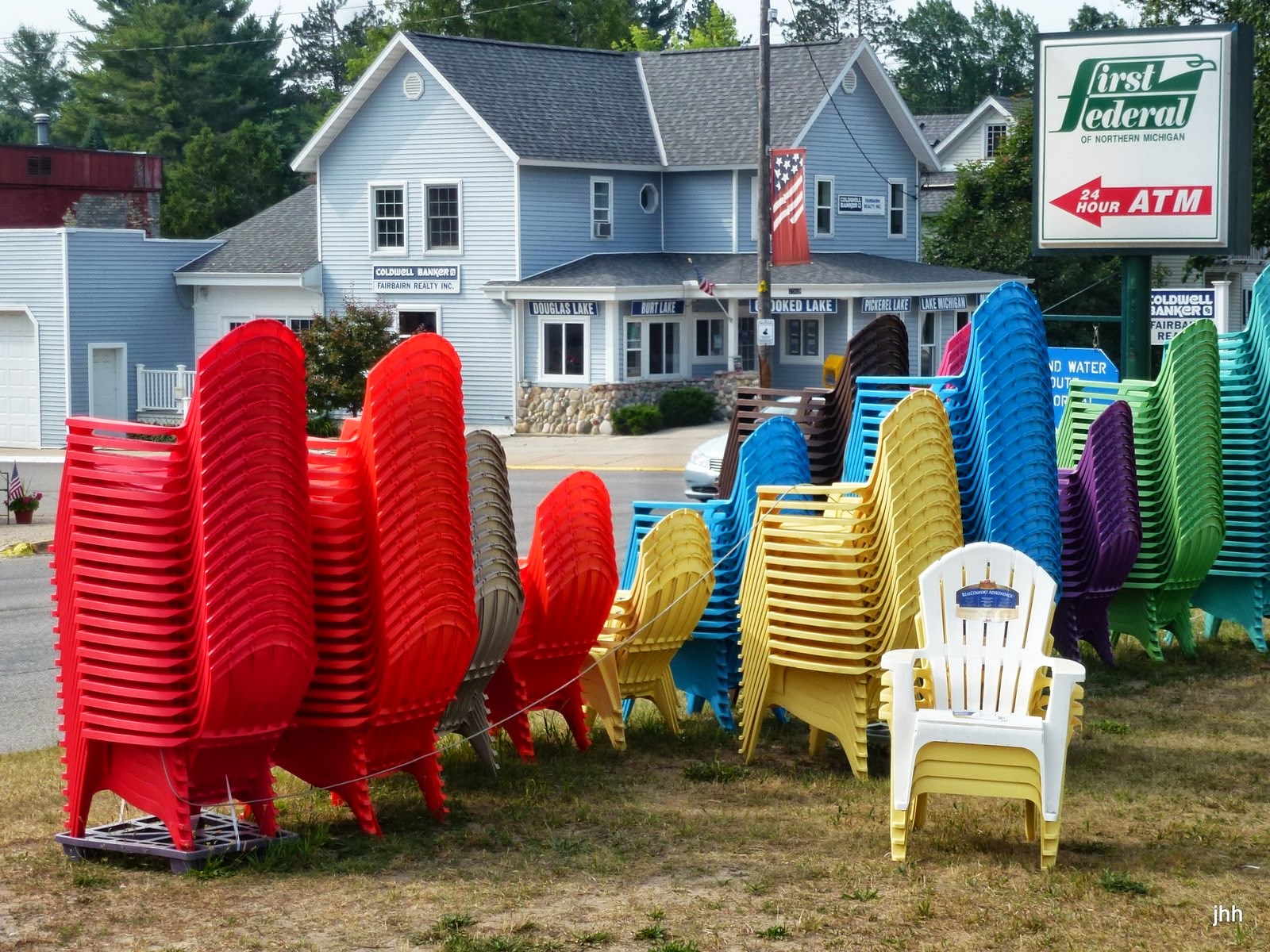
Fairbairn's (family-owned for more than 100 years) hardware store in downtown Alanson, Michigan, gets a truckload of these chairs each summer, stacks them up, and sells them all summer long. Some of the most populat colors are gone already (this shows the last white one, which has since been sold.) It is quite fun each time we come to town to see how the stacks have dwindled as the season progresses. At night they are chained up here beside the highway. I enjoyed watching a couple fit two of them (purple ones!) into a small hatchback a few weeks ago, but I couldn't manage a picture of that. I might buy a couple of these chairs  myself (I love the bright candy-colors, but favor, cowardly, the simple tan color, which is almost gone.) except that this is the WORST mosquito year in memory and we are not sitting around outdoors yet. It feels like never, but it should be possible later in the summer. There ARE fireflies, but I turn off the lights to watch them through the window. And tonight, I should report, there are no sounds of fireworks!

In the background of the photo, you can see the cute gray real-estate office that one of the Fairbairn sons created out of an old place that has housed a variety of different enterprises, most recently a coffee shop.
The heart of the Village of Alanson (check it out on Google Earth) is strung out along the path of the Crooked River, part of a system of lakes and rivers that made it possible for the Ottowa and other tribes to paddle across the tip of Michigan from Lake Michigan all the way to Lake Huron. There is a little museum in town that celebrates that Inland Waterway. On the non-river side, there used to be a railroad that ran through town (I think it brought vacationers and took away lumber) and the old depot currently houses a nice restaurant. People came "up north" from the southern part of the state to get away from summer heat. The museum has photos of them in their 19th Century holiday dresses, hats, and stiff tailoring.

There have been many changes in village and town life in America. I think the networks of people that these towns supported were a great strength that the country has lost. It is fine to see people working so hard to preserve what is left, but it also looks like a precarious enterprise. What do you think?
Muso Soseki , famous for the gardens he designed, as well as his Zen teachings, lived in Japan from 1275-1351. In this poem, translated by W. S. Merwin and Soiku Shigematsu, he puts some faith in the future, Maybe I should, too.


For Myo's Departure for Shofuku-ji


A single true man 
        appears in the world
                and all falsehood vanishes
No need to worry
        that the Way of the Patriarchs
                seems to be declining
This time
        your ax of wisdom
                has found wings
Some day
        surely it will rise up
                and fly

From Muso Soseki's Sun at Midnight, Copper Canyon Press, 2013, page 90.

I am inspired by the way the margin rolls in and back again and by the unpunctuated triolet structure. The single capital letter at the beginning of each section gives a nice artistic touch. Of course, we cannot reproduce in translation the effect of Japanese calligraphy, but attention to the arrangement on the page suggests a similar feeling. Write something pretty tomorrow, using color, special paper or some other method of artistry. Good Night!


Posted by Picasa

Sunday, July 07, 2013

Fireweed and bee spotted today!

 
Strong mid-day wood's-edge light along the road at the south end of the Hymas Woods Nature Preserve shows off the intricate structure of the white parts of the flower. A bee bumbling here and there. There is a tiny red spot below the bee, which seems to be part of the bee. I have seen the yellow pollen baskets on other bees, but could this be a red one? Fireweed in bloom always makes me happy. since I first saw and identified it here just a few years ago. Looking it up, I find that in many parts of the English-speaking world, it is known as willowherb; this sounds very poetic, I think.
There were a few fireworks in the early evening. The sad thing is that the dog tried to dig out again when it got dark. It reminds me of a nervous breakdown, one that continues after the initial manifestation. We are all pretty upset about it.

This lovely flower seems to require Song of the Yodo as the poem for tonight. The Yodo is a river. This  SONG is the final poem (part of a very short section of poems that are not haiku) in the NEW book, Collected Haiku of Yosa Buson, translated by W. S. Merwin & Takako Lento. (It is on page 245.) I have been waiting a long time to be able to learn something more about Buson's haiku. He is particularly interesting to me because of his renown as a painter as well as a giant of haiku poetry. The procedure of this poem reminds me of "linking by scent (or emotion)" a method Basho discussed for the creation of renku poetry, which is created by small groups of people working together. Scent linking implies a connection between verses by agreement in mood or emotion rather than by association of specific things or ideas. Naniwa was later known as the city of Osaka.


SONG OF THE YODO

                              *
A plum flower floats on the stream of Spring
the Uji flows down south and meets the Yodo
do not untie the sash of golden brocade
if you do the swift current will take the boat like lightning

                              *

The Uji water meets the Yodo water
they come together to become one body
I wish to sleep with you on the boat
and become a familiar resident of Naniwa

                               *

You are a plum flower floating on the water
floating down the river swiftly you leave
I am a weeping willow on the river's edge
my shadow is deep in the water
I cannot come with you


Saturday, July 06, 2013

Lost dog found: Luella is home!

This is an older picture of the dog that was frightened by fireworks and ran away on July 4th. We used it on the posters we took all over the village yesterday. She was located about 10 miles away today, so exhausted she just lay in the road. A passing mail carrier saw a grandmother and granddaughter protecting her and alerted my daughter.
When the granddaughter saw how happy she was to see her owner, the child cried.
We are very relieved. I might be a little happier, if people had stopped shooting off fireworks, but it is still going on right now from two different directions! Until about an hour ago, the dog was still frantic; she seems to have settled down some now. There has been a recent change in the fireworks laws in Michigan, so I imagine stories like this can be heard throughout the state. Fireworks were legalized and the burden has been put on the localities to set up the rules for fireworks. I don't hope for much change in the popping tomorrow, but maybe after the weekend??? And maybe if enough dogs and children are terrified, some useful guidelines will be implemented and enforced. Maybe . . .

I know this isn't really a FIREWORKS poem (or sort of) but "they must burn out like used candles," got me when I went to www.Americanpoems.com looking for a poem I might not have to type.


The heroic stars spending themselves,
Coining their very flesh into bullets for the lost battle,
They must burn out at length like used candles;
And Mother Night will weep in her triumph, taking home her heroes.
There is the stuff for an epic poem--
This magnificent raid at the heart of darkness, this lost battle--
We don't know enough, we'll never know.
Oh happy Homer, taking the stars and the Gods for granted.
The Epic Stars by Robinson Jeffers

It has been a very tiring day. And so to bed. . .
Posted by Picasa

Friday, July 05, 2013

Seriously, spring already sprung! Now it is July 5th.

 On the glorious Fourth, the firecrackers almost didn't stop. They've been going off for more than a week now. And as I write they are still going off here in the tranquil hinterlands. 


This lovely dog, seen here last month, when the poppies were at their height next door, tore out of her run and ran away last night. On other years, she hadn't seemed to mind the fireworks, but they went on a lot longer this year. Today we put up LOST DOG posters all over the village. But I am doubtful that she will be found. There is a pack of coyotes in the woods here, and plenty of other dangers.


For me, this afternoon, it was the Habitat for Humanity resale store again, while S did his hot-pool therapy, He does improve slowly, and I am quite encouraged about that.


I bought Selected Poems and Two Plays of William Butler Yeats from 1966. This copy is from the 17th printing, and is larded with student notes. I'm sure you have seen this same volume in a used bookstore. It has a red and black cover featuring an oval photo of the young, bespectacled, Yeats. There are many lyrical beauties inside, and it is hard to choose. I like this one, partly because I think the three beat lines are interesting. And look at the repeated "l" sounds!

THE PITY OF LOVE


A pity beyond all telling
Is hid in the heart of love:
The folks who are buying and selling,
The clouds on their journey above,
The cold wet winds ever blowing,
And the shadowy hazel grove
Where mouse-grey waters are flowing,
Threaten the head that I love.

William Butler Yeats  (1892)  (page 13)

I want to spend an afternoon beside those mouse-grey waters!
Firecrackers are still going off in bunches here

Posted by Picasa

Thursday, July 04, 2013

Seriously. Plus a little bit of flag. Also, Bliss!

 I don't quite get the reference. Is this supposed to be the Abominable Snowman? Or a species of pigmentless gorilla? Anyway his/her furry effigy sits on one of the sofas at the Friendship Center in Petoskey where the seniors sit to wait for the bus. Or I wait while the wonderful massage guy gives S. a massage, after which it will be my turn.
I like to think that the yellow thing around the neck represents a banana, (thus, gorilla?) and was crocheted as a gift by a friendly senior fiber artist. Since it is now so close to the Fourth, an extra small flag is also on display here, visible in the upper right corner of the portrait. Do you ever think that symbols are everywhere and that there must be some species of meaning in everything?

This afternoon on the way to the holiday barbecue to which we were invited, we passed through the hamlet of Bliss, MI. There is nothing much there but a small corner store (The Bliss Store!) and a large field of turf near some restored housing and stabling for the polo players and horses who come here from the South to play polo when it gets too warm where they come from. I kid you not, a polo summer camp! Quite posh.

Tonight's poem is by David Lee, Utah's first poet laureate. Which places him far away from Northern Michigan, where, near midnight now, someone is still setting off fireworks down the lane by the lake.

On Turning Up a Fossil in My Garden


Natural extinction need not connote
a forced or meaningless fall into oblivion:
instead, one of the simple facts of life, the ultimate
fate of all species, not tainted by a stigma
of failures like breath, frequent in occurrence
but unworthy of inordinate praise, not
especially provocative as conversation. As
when two lovers cease their heavy breathing, and part,
and the moonlight seeps into a darkened room:
seen clearly with no apprehension, animosity, fear.

from So Quietly The Earth by David Lee, Copper Canyon Press, 2004, page 20.

Hope you also had a Glorious Fourth, or a least a pleasant one. Good Night!


Wednesday, July 03, 2013

World War II hasn't started yet . . . threads


This is a shout-out to my cousin Marilyn, the blonde with the hairbrush. Her big brother, my much-loved cousin Dwayne, died just a few days ago. Dwayne Brimhall was the oldest grandchild of the woman in this photo, my maternal grandmother Susan Elizabeth Redd Butler, the daughter of Mormon pioneers to the American West.
Since Marilyn lived in Mesa, Arizona and I lived in Schenectady, New York we weren't childhood buddies, or even acquaintances. I came to Mesa this once on the train with my mother to be shown off, and for photos like this one to be taken. It is the summer of 1938, I think. None of us are much concerned about the gathering storm in Europe yet. Though in the end, my mother's youngest brother, my Uncle Merwin, (Elbert Merwin Butler) will go to this war and serve on Okinawa.

Here is a letter Merwin sent us from Okinawa that my mother saved. At the time the photo was taken, most of the people in the salutation hadn't yet been born. Four little brothers and a sister! In the photo I am still an only child.

See the rubber stamp on the envelope? I Googled the phrase and found out that there weren't enough ships to transport the troops home rapidly after the war ended, so they carved this stamp (probably from an eraser) to put on letters sent home. It's an electoral threat. (Single-click on the image to enlarge.)

I've mentioned my thrift-store book-shopping expeditions. Last week I also got Winston Churchill's Memoirs of the Second World War, which is an abridgment of his 6-volume history published in 1959. ( I had always thought I would read that. Someday!) Still, it comes in at a respectable, if daunting, 1016 pages! There is a new introduction and an epilogue. I knew Churchill was a good writer--we all know tag-phrases from his great speeches--but I must say it is a pleasure to read clear and expressive English like this! So, once again, Franz Kafka in the also very well-written book by Frederick R. Karl, has to wait. . .

This is from Churchill's first chapter, "The Follies of the Victors" I want you to pay special attention to the masterful use of semicolons in series to convey the building blocks of a reasoned assessment.

"It is my purpose as one who lived and acted in these days, to show how easily the tragedy of the Second World War could have been prevented; how the malice of the wicked was reinforced by the weakness of the virtuous; how the structure and habits of democratic states, unless they are welded into larger organisms. lack those elements of persistence and conviction which alone can give security to humble masses; how,even in matters of self-preservation, no policy is pursued for even ten or fifteen years at a time. We shall see how the counsels of prudence and restraint may become the prime agents of mortal danger; how the middle course adopted from desires for safety and a quiet life may be found to lead direct to the bull's-eye of disaster. We shall see how absolute is the need of a broad path of international action pursued by many states in common across the years, irrespective of the ebb and flow of national politics.

It was a simple policy to keep Germany disarmed and the victors adequately armed for thirty years, and in the meanwhile, even if a reconciliation could not be made with Germany, to build ever more strongly a true League of Nations capable of making sure that treaties were kept, and changed only by discussion and agreement. When three or four powerful governments acting together have demanded the most fearful sacrifices from their peoples, when these have been given freely for the common cause, and when the longed-for result has been attained, it would seem reasonable that concerted action should be preserved so that at least the essentials would not be cast away. But this modest requirement the might, civilisation, learning, knowledge, science, of the victors were unable to supply. They lived from hand to mouth and from day to day, and from one election to another, until, when scarcely twenty years were out, the dread signal of the Second World War was given, and we must write of the sons of those who had fought and died so faithfully and well:

"Shoulder to aching shoulder, side by side,
They trudged away from life's broad wealds of light."
--Siegfried Sassoon"
(Churchill, pages 12-13)
*********
(June here again!) I want you to notice the stunning cumulation of long series strung together by commas.
And because we are on THIS blog, the use made of quoted poetry to wind things up.

I'll wind this us for now. Except that I can't help thinking about the current world, the lighted flares which threaten to become greater, or even lesser, conflagrations, consuming lives and property like something from Biblical prophecy. You need only to visit one cemetery, or know one wounded veteran to gather deep resolve to do something, if only we knew something to do!